Table of Contents
- 1. The Scheme Your Trust Deed Cites No Longer Exists
- 2. What Carried Over Unchanged
- 3. Change 1: Exemption Became a Three-Year Term
- 4. Change 2: A Ceiling on What the Board Can Declare
- 5. Change 3: New Forms, Digital by Default
- 6. Change 4: Losses, and a Two-Month Clock
- 7. Change 5: Corporate Actions No Longer Auto-Revoke
- 8. What To Do in the Next Thirty Days
The Scheme Your Trust Deed Cites No Longer Exists
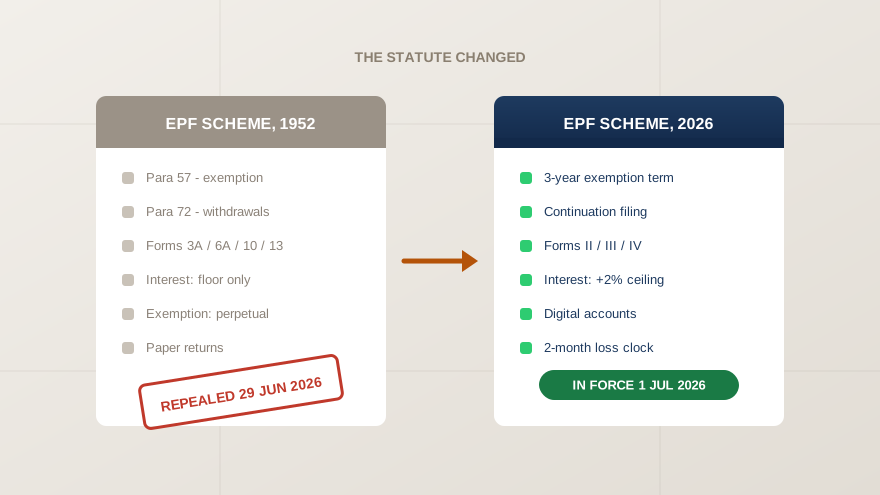
On 29 June 2026 the Central Government notified the Employees' Provident Funds Scheme, 2026 under the Code on Social Security, 2020. It was gazetted on 1 July 2026 and took effect from that date, replacing the Employees' Provident Funds Scheme, 1952 outright. If your trust deed, your PF Trust Rules, your audit checklist or your inspection file cites "paragraph 57" or "paragraph 72" of the 1952 Scheme, those references now point at a repealed instrument.
For most employers this is a payroll-configuration exercise. For an EPFO-exempted establishment running its own provident fund trust, it is considerably more than that. The 2026 Scheme rewrites the terms on which exemption is granted, renewed, reported and revoked. Exemption is no longer a permanent status with an annual filing attached to it — it is a three-year licence with a renewal test, a new set of statutory forms, a ceiling on what the Board of Trustees may declare, and a two-month clock attached to losses.
This article is the EPF Scheme 2026 vs 1952 comparison for exempted trusts specifically: what carried over unchanged, what changed in substance, and what has no counterpart in the old Scheme at all. It is the reference point for the more detailed articles linked throughout, and the companion to our EPF Scheme 2026 compliance guide for exempted PF trusts.
What Carried Over Unchanged
Start with the reassuring part, because it is genuinely large. The statutory contribution rate remains 12 per cent of wages for both employer and employee. The wage ceiling stood at ₹15,000 at the point of notification — the Union Cabinet subsequently approved a revision to ₹25,000 on 16 September 2026, which we cover separately in our analysis of what the ₹25,000 ceiling does to a trust's member ledger.
The fundamental architecture of exemption survives. An establishment may still be exempted from the operation of the Scheme where it runs its own provident fund providing benefits that are, in the long-standing formulation, at least as favourable as those under the statutory Scheme. The Board of Trustees remains the governing body. The 85/15 pattern of investment discipline remains the framework within which the corpus must be deployed, and our guide to PF trust investment norms in India remains materially accurate on that point.
The EPFO Standard Operating Procedure of October 2023 also continues to govern how inspections of exempted establishments are actually conducted. The SOP is an administrative instrument; the Scheme is the statute beneath it. The 2026 Scheme did not withdraw the SOP — it changed several of the substantive obligations the SOP tests for.
Change 1: Exemption Became a Three-Year Term
Under the 1952 framework, an exemption order granted under Section 17 was in practice perpetual. It could be cancelled for cause, but it did not expire. Under the 2026 Scheme, a fresh exemption order is valid for three years. Extension must be applied for through the portal at least six months before expiry, and renewal is conditional — among other things, on the establishment's net worth not having remained negative for three or more consecutive years.
Establishments already holding exemption are not grandfathered indefinitely. They are required to apply for continuation within two years of the notification of the Social Security (Central) Rules, 2026 — the clock on that window runs from 8 May 2026. This is the single most consequential administrative deadline facing an exempted trust today, and it is the one most likely to be missed, because nothing arrives in the post to remind you of it.
Practically, this converts exemption from a status you hold into a case you periodically have to make. The evidence for that case — trustee minutes, audited accounts, investment compliance records, interest declarations — has to exist in retrievable form on the date you file, not be assembled in the fortnight before. See Form-II, Form-III and Form-IV for what the filing itself now consists of.
Change 2: A Ceiling on What the Board Can Declare
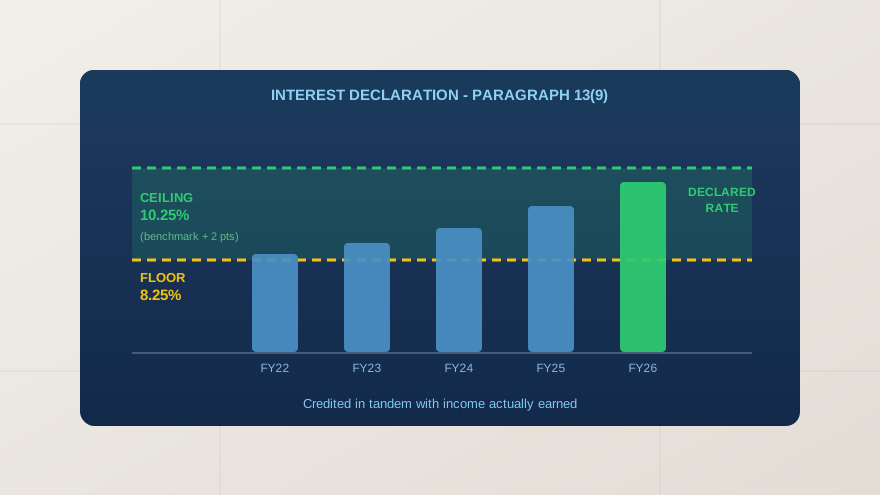
The 1952-era obligation was a floor: an exempted trust had to credit its members at a rate not lower than the statutory rate declared by the Central Government — 8.25 per cent for FY 2025-26. Beating that rate was a competitive virtue and, for well-invested trusts, a routine occurrence.
The 2026 Scheme adds a ceiling on top of that floor. Interest must be credited in tandem with the income the trust has actually earned during the year, and is capped at two percentage points above the statutory benchmark rate. Paragraph 13(9) requires the Board of Trustees to declare the rate annually, commensurate with income earned. A trust that has historically smoothed a generous rate out of accumulated reserves now has to be able to show the income behind the number.
This is the change most likely to surprise a trustee board, because it constrains a decision the board previously took with wide discretion. We work through the arithmetic and the surplus question in the new 2 per cent interest ceiling and what your board can and cannot declare.
Change 3: New Forms, Digital by Default
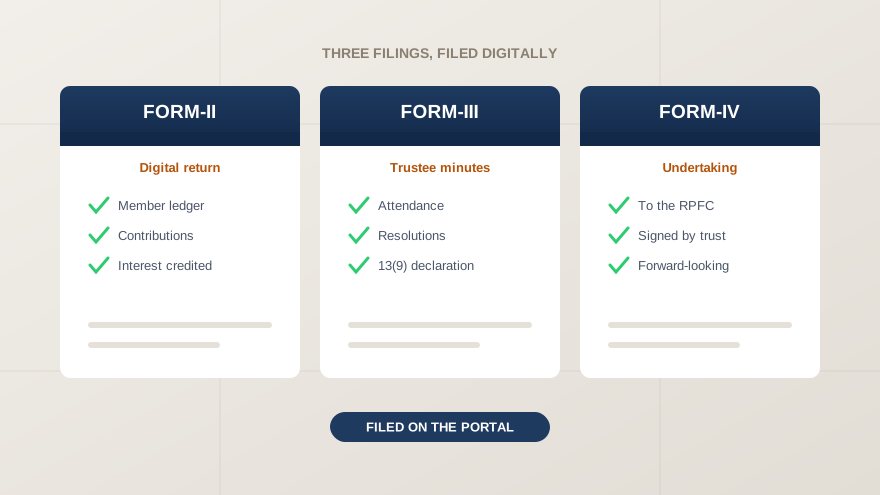
The forms an exempted trust lives with have changed names and numbers. The 1952-era vocabulary of Forms 3A, 6A, 10, 13 and 31 is being displaced by a smaller set of exempted-establishment artefacts: Form-II for the return, filed digitally; Form-III for trustee meeting minutes; and Form-IV for a written undertaking to the Regional Provident Fund Commissioner.
Alongside the forms sit three digital mandates that are easy to read past and expensive to fail. Trust accounts must be maintained digitally. The PF Trust Rules must be circulated to members and translated into the language of the majority of them. And each member must be issued a statement of account within two months of the close of the financial year — a service-level obligation, not a filing, and one that most trusts running on spreadsheets cannot currently meet at scale.
The practical consequence is that record-keeping which was defensible in 2023 may not be defensible at your continuation filing. Our guide to migrating from Excel to PF trust management software covers the mechanics of closing that gap.
Change 4: Losses, and a Two-Month Clock
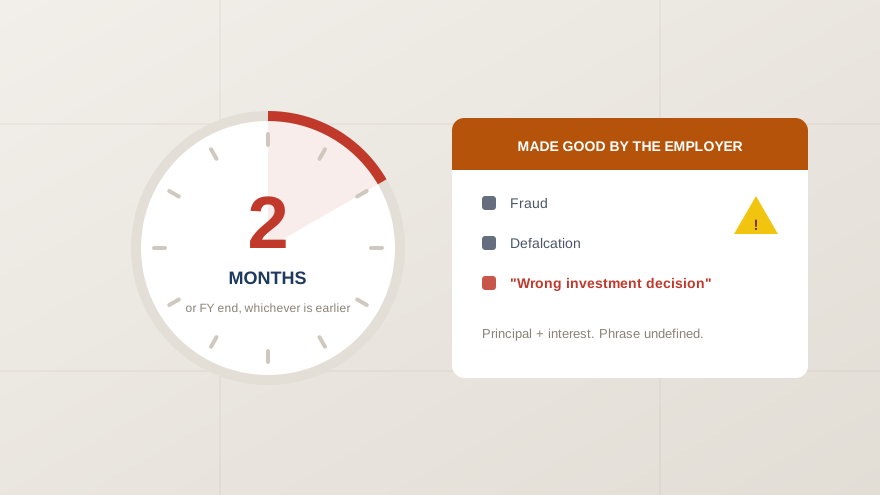
The 2026 Scheme requires that losses to the fund arising from fraud, defalcation or a "wrong investment decision" be made good by the employer — principal and interest — within two months of the loss or by the end of the financial year, whichever is earlier. Willis Towers Watson, in its clause-by-clause read of the Scheme, has publicly flagged the phrase "wrong investment decision" as undefined, and notes that the line between making good a loss and making good an interest loss appears blurred.
There was no equivalent express timeline in the 1952 Scheme. Trustee exposure existed, but it ran through general fiduciary principles and EPFO enforcement rather than a stated deadline. The change matters less for the size of the liability than for the speed at which it now crystallises, and for what a trustee should be documenting before a decision, not after it. We take a position on that in the two-month clock trustees should fear.
Change 5: Corporate Actions No Longer Auto-Revoke
This one runs in the trust's favour. Under the earlier framework, a merger, demerger, amalgamation or the formation of a subsidiary could put an establishment's exemption in immediate jeopardy, and finance teams planning a restructuring routinely treated the PF trust as a casualty of the transaction. Under the 2026 Scheme, corporate actions do not automatically revoke exemption; the status of the exemption is determined by a competent legal forum.
For CFOs, this changes the shape of the stay-or-surrender calculation, because one of the historic arguments for surrendering — that the next transaction would end the trust anyway — has lost most of its force. It does, however, introduce a legal process where there used to be an administrative outcome. We re-run the full decision framework in stay exempt or surrender after EPF Scheme 2026.
What To Do in the Next Thirty Days
First, establish where your continuation filing stands. If nobody in your organisation can state the date by which your establishment must apply for continuation, that is the finding — the two-year window from 8 May 2026 is running whether or not it has been diarised.
Second, read your trust deed and PF Trust Rules against the 2026 Scheme rather than against the 1952 Scheme they were drafted for. Lakshmikumaran & Sridharan argued in September 2026 that aligning exempt trust rules with the new labour codes and the 2026 Scheme is the need of the hour; our clause-level amendment checklist turns that into a working document. Remember that any change to trust rules or trustees has to be communicated to both EPFO and the Income Tax Department.
Third, test whether your current systems can produce a digital Form-II return, evidence Form-III minutes for the last three years, and issue member statements within two months of financial-year close. MyPF Software was built for exactly these obligations, and the fastest way to see whether your trust is ready is to walk through the EPFO compliance checklist or book a 30-minute readiness review.
Ready to simplify your PF trust compliance?
MyPF Software helps exempted PF trusts stay inspection-ready, automate filings, and manage investments — all in one platform built for India.