Table of Contents
- 1. The Document Nobody Has Opened Since the 2026 Scheme
- 2. Clause 1: The Wage Definition
- 3. Clause 2: Interest Declaration Mechanics
- 4. Clause 3: Member Communication, and the New Digital Duties
- 5. Clause 4: Forms, Governance and the Loss Provision
- 6. Clause 5: Benefits, Withdrawals and the "At Least As Favourable" Test
- 7. Who Has to Be Told — and What Happens Next
The Document Nobody Has Opened Since the 2026 Scheme
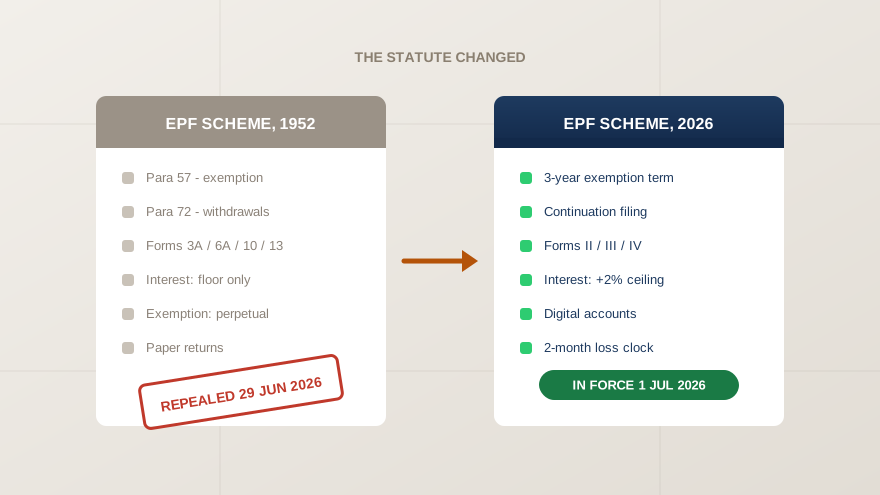
Your PF Trust Rules and trust deed were almost certainly drafted against the Employees' Provident Funds Scheme, 1952. They cite its paragraphs, use its forms, adopt its wage definition and reproduce its interest obligation. That Scheme was replaced on 29 June 2026 by the Employees' Provident Funds Scheme, 2026, notified under the Code on Social Security, 2020.
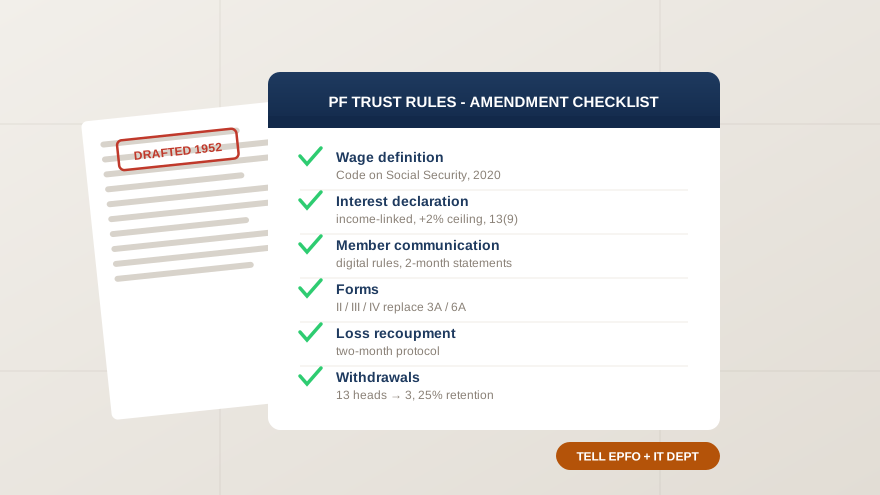
Lakshmikumaran & Sridharan argued in September 2026 that aligning exempt PF trust rules with the new labour codes and the 2026 Scheme is the need of the hour. We agree, and this article turns that argument into a working checklist a company secretary and a trust administrator can take to the Board of Trustees. It is organised by clause, because that is how the amendment exercise actually gets done.
One framing point before the list. This is not a cosmetic update. Under the 2026 Scheme, exemption is a three-year renewable term and existing exempted establishments must apply for continuation within two years of the notification of the Social Security (Central) Rules, 2026 — a window running from 8 May 2026. Trust rules that contradict the Scheme are evidence going into that review.
Clause 1: The Wage Definition
Start here, because everything downstream computes off it. The Code on Social Security, 2020 uses its own definition of wages, structurally different from the definition most 1952-era trust rules reproduce. If your rules define contributory wages by listing basic and dearness allowance in the language of the old Scheme, that clause has to be re-cut against the Code.
Two practical cautions. First, the definitional change flows into contribution computation, settlement values and the interest base, so an amendment here is a payroll-configuration change as much as a legal one; sequence them together. Second, under the 2026 Scheme employer matching above the statutory ceiling is no longer mandatory, while the anti-avoidance rule on cosmetic salary restructuring remains fully applicable — so do not treat the redefinition as an opportunity to restructure wage components downward.
Clause 2: Interest Declaration Mechanics
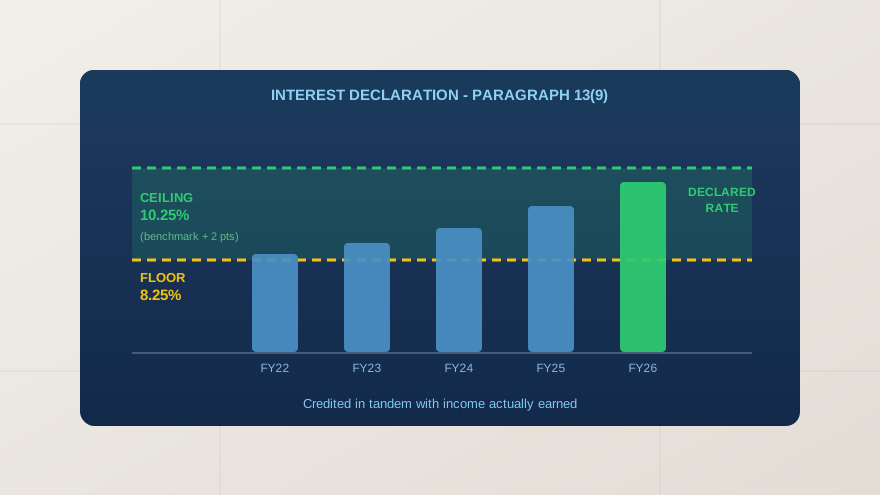
Most trust rules written under the 1952 framework say something close to: the trust shall credit interest at a rate not lower than the rate declared by the Central Government. That clause is now incomplete in a way that matters. Under the 2026 Scheme the declared rate must be credited in tandem with income actually earned by the trust and is capped at two percentage points above the statutory benchmark, and paragraph 13(9) requires the Board of Trustees to declare the rate annually.
The amended clause needs four things the old one did not have: the income-linkage test, the ceiling, the annual declaration obligation vested expressly in the Board, and a stated basis for computing the income against which the rate is justified. Add a surplus clause while you are in the document — the ceiling structurally produces retained surplus in strong years, and EPFO has previously issued guidance on the utilisation of reserves and surplus in exempted trusts. Our article on the interest ceiling and the board declaration covers the arithmetic this clause has to support.
Clause 3: Member Communication, and the New Digital Duties
The 2026 Scheme creates member-facing obligations that most trust rules are silent on. The PF Trust Rules themselves must be circulated to members and translated into the language of the majority of them. Trust accounts must be maintained digitally. And every member must be issued a statement of account within two months of the close of the financial year.
Amend the rules to state each of these as a duty of the trust, with a named owner. The translation requirement in particular is easy to nod past and visible at inspection — it requires a decision about which language, a translated document, and evidence of circulation. The two-month member statement is a service level, and a trust that cannot hit it is exposed regardless of how good its books are. We make the governance case for closing that gap in fixing the exempted-trust member experience.
Clause 4: Forms, Governance and the Loss Provision
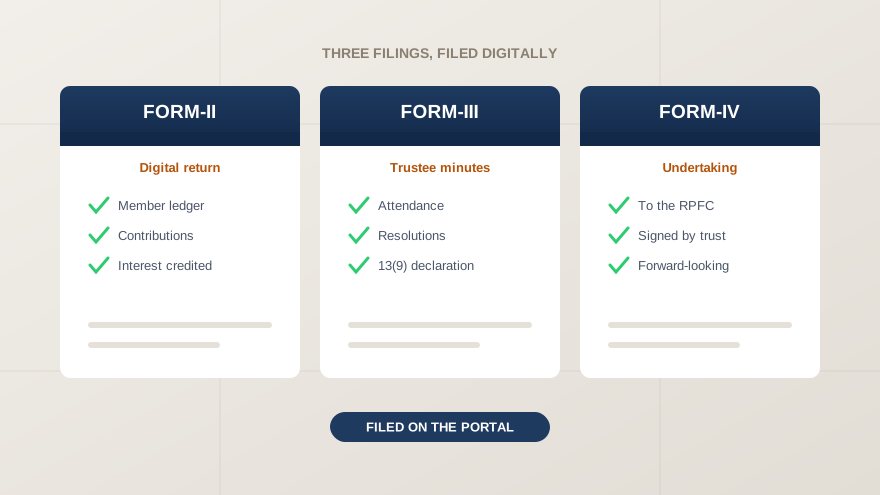
Replace every reference to the 1952-era forms with the current artefacts: Form-II for the digitally filed return, Form-III for trustee meeting minutes, Form-IV for the written undertaking to the Regional Provident Fund Commissioner. Rules that instruct the trust to file Form 3A and Form 6A as its statutory return are instructing it to do something that is no longer the obligation.
Then add the two governance provisions the old rules have no equivalent for. The first is the loss provision: losses from fraud, defalcation or a wrong investment decision are to be made good by the employer, principal and interest, within two months of the loss or by financial-year end, whichever is earlier. Put the internal protocol in the rules — notification, quantification, board approval, employer funding — so that the two-month clock runs against a process rather than an improvisation.
The second is the exemption-term machinery: continuation and renewal filing responsibility, the six-months-before-expiry application timing for fresh three-year orders, and who owns the calendar. A rule that makes the renewal date somebody's named responsibility is worth more than any amount of good intention. See the three filings every exempted trust now owes for what each artefact contains.
Clause 5: Benefits, Withdrawals and the "At Least As Favourable" Test
The long-standing golden rule of exemption is that the benefits provided by the trust must be at least as favourable as those under the statutory Scheme. The 2026 Scheme rewrote the withdrawal framework substantially: the thirteen withdrawal categories collapse into three — Essential Needs, Housing and Special Circumstances — up to 100 per cent of the eligible balance becomes accessible subject to a 25 per cent minimum retention, and full withdrawal on unemployment now requires twelve months rather than two.
An exempted trust whose rules still list the old withdrawal heads and limits is at risk of being less favourable than the statutory Scheme in some scenarios and more permissive in others — both of which are problems. Map your rules against the three new categories, the retention floor and the unemployment waiting period, and implement the result in your settlement workflow, not just in the document.
Who Has to Be Told — and What Happens Next
Amending trust rules is not an internal act. Practitioners on India's HR and PF forums make the point repeatedly: any change in the trust rules or in its trustees has to be communicated to both EPFO and the Income Tax Department, because the trust's recognition for income-tax purposes and its exemption under the PF law are separate statuses maintained by separate authorities. Plan both notifications into the amendment timeline from the start.
A workable sequence: draft the amendments against this checklist with counsel; table them at a properly constituted Board of Trustees meeting and record the resolution in Form-III; obtain employer and, where required, statutory approvals; notify EPFO and the Income Tax Department; circulate the amended rules to members in the majority language; and update the systems that operationalise them — contribution basis, interest computation, withdrawal categories and statement generation.
That last step is where amendments usually stall, because a rule the software cannot execute is a rule the trust does not actually follow. MyPF Software implements the contribution, interest, withdrawal and reporting mechanics the 2026 Scheme requires, and produces the trustee-meeting and member-communication records that evidence them. Walk the compliance checklist, or book a 30-minute review of your trust rules against the new Scheme.
Work the checklist against the continuation filing requirements rather than in isolation — amended rules are part of what the RPFC reads at renewal.
Ready to simplify your PF trust compliance?
MyPF Software helps exempted PF trusts stay inspection-ready, automate filings, and manage investments — all in one platform built for India.