Table of Contents
A New Vocabulary for Exempted Establishments
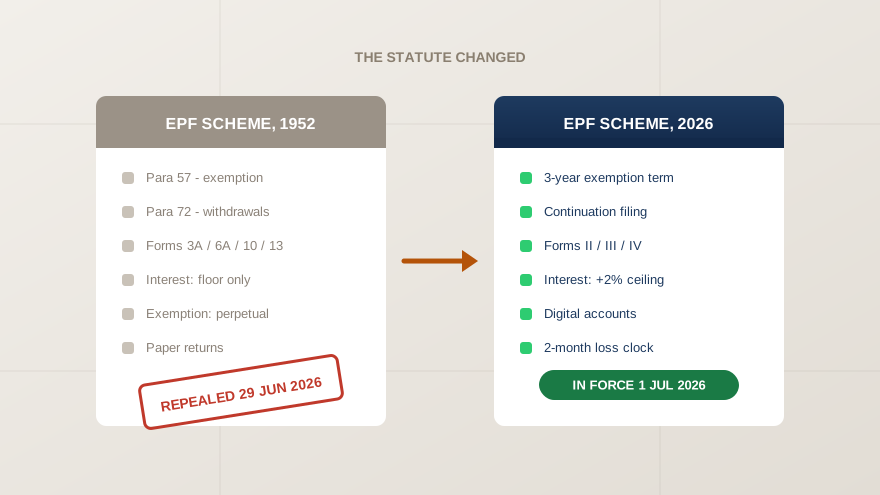
Ask a PF trust administrator which forms they file and you will hear the 1952-era list: Form 3A, Form 6A, Form 10, Form 13, Form 31. Every competing software vendor still publishes glossary pages against that vocabulary. It is now, for exempted establishments, largely historical.
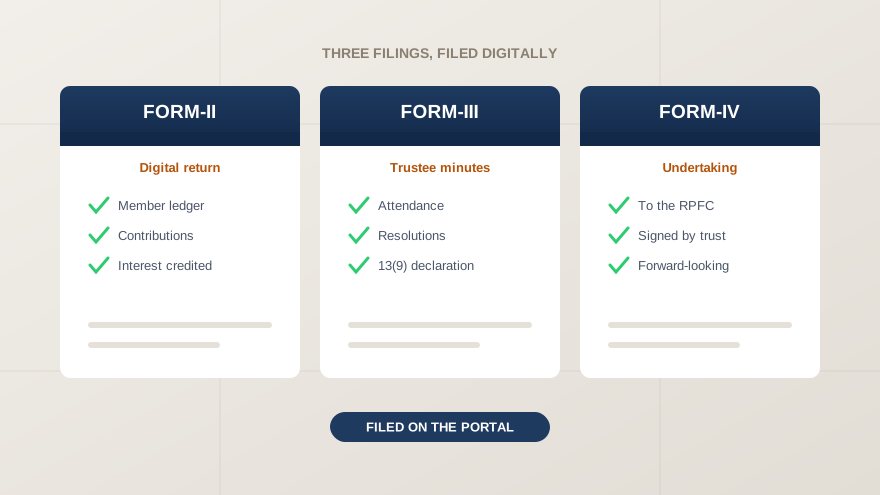
The Employees' Provident Funds Scheme, 2026 brings a compact set of exempted-establishment artefacts in its place. Form-II is the return, and it must be filed digitally. Form-III is the prescribed record of trustee meeting minutes. Form-IV is a written undertaking furnished to the Regional Provident Fund Commissioner. Together they are the documentary spine of the new regime, and they are what a continuation or renewal application will be judged on.
This article walks each one — who signs, what attaches, how it is filed, and where trusts most often come unstuck. For the wider picture of what the 2026 Scheme changed, start with our EPF Scheme 2026 vs 1952 comparison.
Form-II: The Return, Filed Digitally
Form-II is the exempted establishment's periodic return to EPFO, and the material change is not the content so much as the channel: it is to be filed digitally, and the trust accounts behind it are to be maintained digitally. A return compiled by hand from spreadsheets, printed, signed and walked to a regional office is no longer the intended route.
What that means operationally is that the data feeding Form-II has to be continuously correct rather than periodically reconstructed. Member-wise contributions, interest credited, settlements, transfers, loans and closing balances all have to tie to the trust's books at the moment of filing. Where those numbers live in several workbooks maintained by different people, the reconciliation effort — and the risk of a mismatch EPFO can see — grows with every filing cycle.
The signature and responsibility sit with the establishment and its trustees, not with the software. But the difference between a Form-II that takes an afternoon and one that takes three weeks is entirely a systems question, which is the argument we make in detail in our buyer's guide to PF trust software.
Form-III: Trustee Minutes, and Why It Catches Trusts Out
Form-III is the prescribed form in which trustee meeting minutes are to be recorded. On paper it is the least demanding of the three. In practice it is the one that most often produces an adverse finding, for a simple reason: minutes cannot be created retrospectively with any credibility, and a great many trusts have historically kept them informally.
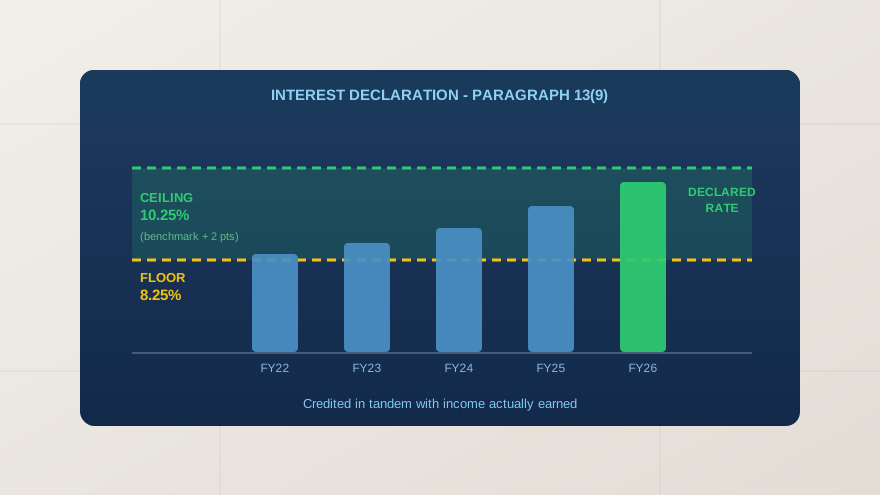
A Form-III minute has to carry the things an inspector or a renewal reviewer will look for — the date and place of the meeting, who attended, what was tabled, and what was resolved. The resolutions that matter most are the interest declaration under paragraph 13(9), investment decisions and the pattern-of-investment position, the handling of any loss or shortfall, and the approval of returns and member communications. A minute that records attendance but not decisions is evidentially thin.
The compounding problem is history. Continuation and renewal reviews look backwards. If your trust has held meetings but recorded them in an email thread, or signed minutes but never dated them, the gap is not fixable once a filing is in motion. The remedy is to move the minute-taking process onto a structured, dated, retrievable footing now, and to keep the last three years of records in one place. Our inspection guide covers how these records are actually tested on the day.
Form-IV: The Undertaking to the RPFC
Form-IV is a written undertaking furnished to the Regional Provident Fund Commissioner. An undertaking is a different kind of document from a return: it is a forward-looking commitment by the establishment about how the fund will be administered, rather than a report on what happened.
That distinction has a governance consequence worth stating plainly. Undertakings are signed by people. Before Form-IV is furnished, the signatory should be satisfied that the establishment can actually deliver what is being undertaken — digital accounts, digital returns, timely member statements, minuted trustee meetings, the interest-declaration mechanics and the loss-recoupment timeline. Signing an undertaking the trust is not operationally equipped to honour converts a systems weakness into a personal exposure, a theme we develop in PF trust trustee liability in India.
How the Three Fit the Continuation Filing
These forms are not free-standing paperwork. They are the evidence base for the new, time-bound shape of exemption. Under the 2026 Scheme a fresh exemption order runs for three years, extension has to be applied for on the portal at least six months before expiry, and establishments already exempted must apply for continuation within two years of the notification of the Social Security (Central) Rules, 2026 — a window whose clock runs from 8 May 2026.
When that application is reviewed, Form-II shows whether the trust has been reporting; Form-III shows whether it has been governing; Form-IV shows what it has committed to. A trust that can produce all three cleanly, for the full look-back period, is making a strong case. A trust that can produce returns but not minutes is making a weak one.
Willis Towers Watson's practical recommendation to exempted establishments was to prepare a continuation or renewal readiness pack. That is exactly the right framing: assemble the three forms and their supporting evidence as a standing pack, kept current, rather than as a project that starts when the deadline is six weeks away.
Producing the Three Forms Without a Fire Drill
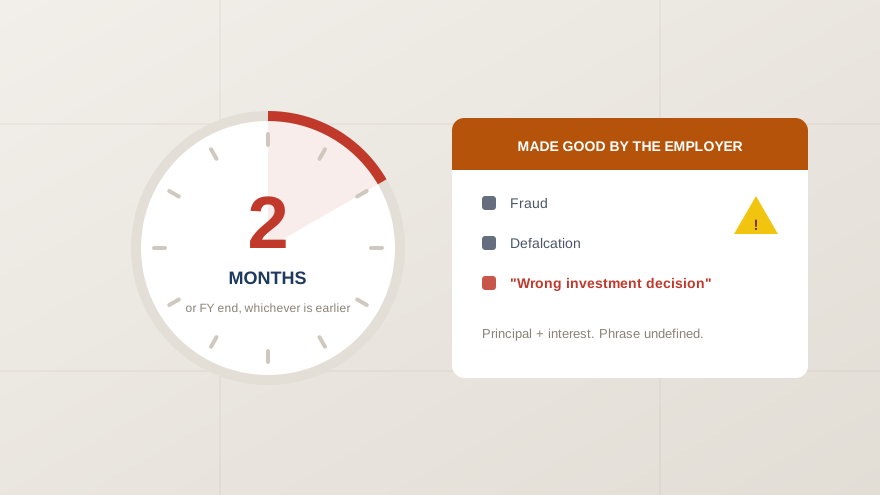
Every one of these obligations is a data problem before it is a legal one. Digital accounts, a digital return, minuted decisions tied to the numbers that drove them, statements to members within two months of financial-year close — each is straightforward with a system of record and painful without one.
MyPF Software maintains the trust's books digitally, generates statutory returns from the same ledger that produces member statements, and keeps trustee-meeting records and investment-compliance evidence in one retrievable place, so the continuation pack is a report rather than a reconstruction. Walk through the EPFO compliance checklist to see where your trust currently stands, or book a demo and we will produce the three forms live against your own structure.
If a continuation application is the reason you are reading this, the exemption continuation page sets out the filing window, the net-worth condition and what a renewal readiness pack has to contain.
Ready to simplify your PF trust compliance?
MyPF Software helps exempted PF trusts stay inspection-ready, automate filings, and manage investments — all in one platform built for India.