Table of Contents
- 1. Why the Decision Has to Be Re-taken
- 2. New Variable 1: Exemption Is Now a Renewable Term
- 3. New Variable 2: The Interest Ceiling Caps the Upside
- 4. New Variable 3: The Two-Month Loss Clock
- 5. New Variable 4: Corporate Actions Cut Both Ways
- 6. New Variable 5: The Continuation Filing Burden Is Now Quantifiable
- 7. The Refreshed Framework, in One Table's Worth of Thinking
Why the Decision Has to Be Re-taken
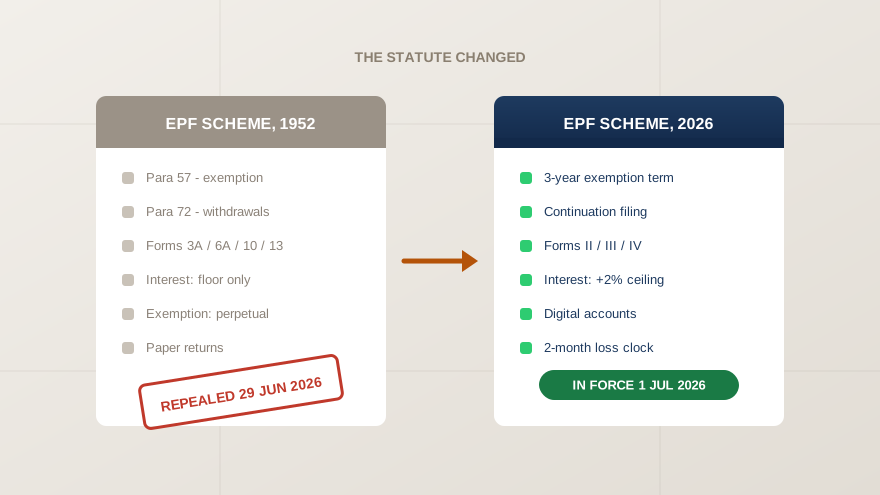
We published a CFO decision framework for surrendering PF trust exemption in India before the Employees' Provident Funds Scheme, 2026 existed. Its logic still holds: compare the annual compliance cost of running a trust against the investment surplus it generates, price the trustee liability exposure, and add the one-time cost of surrender. But three of the inputs have changed and two new ones have appeared, and Willis Towers Watson's first recommendation to exempted establishments after the 2026 Scheme was, in substance, to revisit this exact choice.
Google's own search data says the question is being asked constantly — the exempted-versus-unexempted comparison appears in people-also-ask panels four separate ways. What follows is the refreshed framework, with the new variables priced in. Read it alongside our original surrender decision framework, which remains the right treatment of the process and the timeline.
New Variable 1: Exemption Is Now a Renewable Term
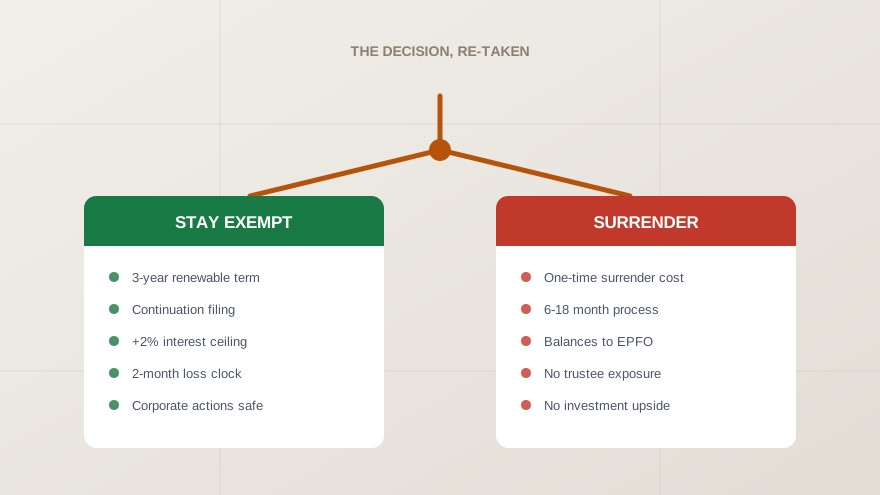
A fresh exemption order under the 2026 Scheme is valid for three years. Extension has to be applied for on the portal at least six months before expiry, and renewal is conditional — including on the establishment's net worth not having remained negative for three or more consecutive years. Establishments already exempted must apply for continuation within two years of the notification of the Social Security (Central) Rules, 2026, a window running from 8 May 2026.
This converts a fixed asset into a lease. The cost of exemption is no longer just the cost of running the trust; it is the cost of periodically re-establishing the right to run it, forever. For a stable, well-documented trust that is an administrative line item. For an establishment with a thin compliance history or a volatile balance sheet, it is a recurring risk that the trust may simply not be renewed at a moment of its choosing — which is a materially different thing to plan around than a permanent status.
New Variable 2: The Interest Ceiling Caps the Upside
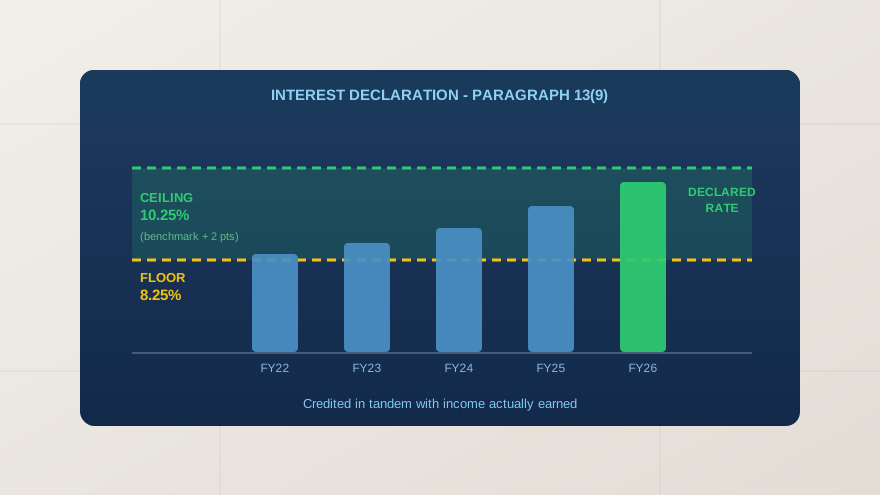
The historic financial case for exemption was the surplus: a well-managed corpus outperformed the statutory rate and passed the difference to members, buying goodwill and justifying the compliance overhead. The 2026 Scheme caps the declared rate at two percentage points above the statutory benchmark and requires it to track income actually earned, with an annual Board declaration under paragraph 13(9).
For most trusts, two points of headroom above 8.25 per cent is more than they have historically delivered, so the cap will not bind. But it does something subtler to the business case: it converts the upside from unlimited to bounded while leaving the downside — the obligation to credit at least the statutory rate in a bad year — entirely intact. A bounded upside against an unbounded compliance obligation is a worse trade than the one CFOs originally signed up to, and it should be priced as such. The detail is in our article on what your board can and cannot declare.
New Variable 3: The Two-Month Loss Clock
Losses from fraud, defalcation or a "wrong investment decision" must be made good by the employer, principal and interest, within two months of the loss or by financial-year end, whichever is earlier. The phrase "wrong investment decision" is undefined, and WTW has flagged the ambiguity publicly.
In a stay-or-surrender model, this is a contingent employer liability with an undefined trigger and a short cure period. It should appear in the analysis as an explicit risk-weighted number, informed by the trust's investment governance quality — a trust with a written investment policy, limit checks and minuted decisions carries far less of this exposure than one where investments are approved informally. Our position on documenting against it is in the two-month clock trustees should fear.
New Variable 4: Corporate Actions Cut Both Ways
This one favours staying. Mergers, demergers, amalgamations and subsidiary formations no longer automatically revoke exemption under the 2026 Scheme; the status of the exemption is decided by a competent legal forum. One of the standing arguments for surrender — that an anticipated transaction would end the trust regardless — has largely gone.
The replacement is a legal process rather than an administrative certainty, which has its own cost and timeline. But for a group with corporate activity on the horizon and an otherwise healthy trust, the change removes a reason to surrender pre-emptively. It should be scored positively, with a provision for the legal process it substitutes.
New Variable 5: The Continuation Filing Burden Is Now Quantifiable
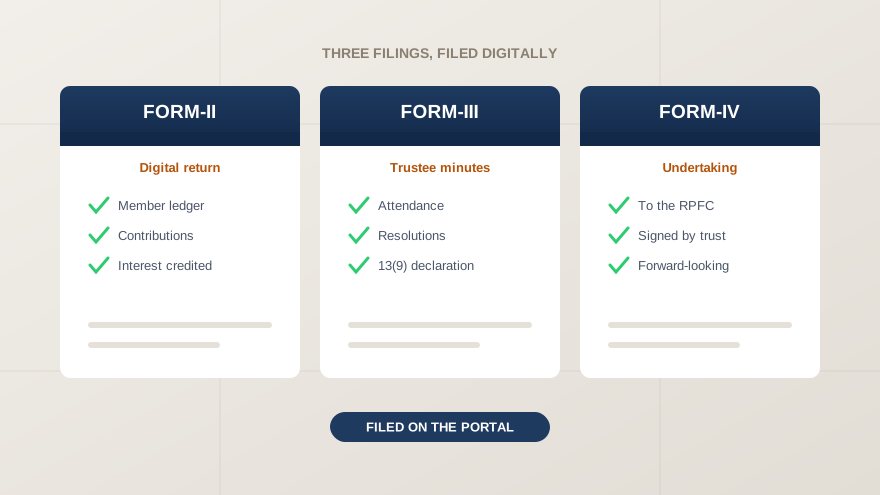
The 2026 Scheme is specific about what an exempted trust must produce: Form-II returns filed digitally, Form-III trustee minutes, a Form-IV undertaking to the Regional PF Commissioner, digitally maintained trust accounts, PF Trust Rules circulated to members in the language of the majority, and member statements issued within two months of financial-year close.
That specificity is useful, because it makes the compliance cost estimable instead of notional. Cost it honestly: software, statutory audit, actuarial and advisory support, the fully-loaded time of the administrator and the finance staff involved, and the trustee time the governance calendar now requires. Our walkthrough of Form-II, Form-III and Form-IV is a reasonable basis for that estimate, and the software line item is published rather than guessed.
The Refreshed Framework, in One Table's Worth of Thinking
Score five things. One: annual compliance cost, fully loaded, using the 2026 obligation list rather than the 1952 one. Two: five-year average investment surplus above the statutory rate, now capped at two points of headroom. Three: risk-weighted trustee and employer exposure, including the loss-recoupment clock, discounted by the quality of your investment governance. Four: renewal risk — the probability, honestly assessed, that continuation or a future three-year renewal is refused or delayed, and what that would cost operationally. Five: the one-time cost of surrender, which our original framework puts at a six to eighteen month process depending almost entirely on the state of your records.
Two conclusions tend to fall out. A trust with a corpus below roughly ₹20–25 crore, a thin compliance history and no systems is now harder to justify than it was in 2025 — the new filing burden lands on the same small surplus. A trust with scale, clean records and real investment capability is, if anything, safer than before, because corporate actions no longer threaten it and the compliance obligations are at last written down clearly enough to be managed.
What tilts a marginal case is almost always record quality. It determines the compliance cost, the renewal risk, the loss-detection latency and the surrender timeline simultaneously. MyPF Software can produce the compliance-cost and investment-performance reporting this analysis needs from your own data — book a session to work through the model, or contact us if the decision is already made and you need the trust ready either way.
If the decision lands on staying exempt, the next question is how you run it. We compare EPF trust software against Excel and outsourced administration on exactly the 2026 obligations costed above.
Ready to simplify your PF trust compliance?
MyPF Software helps exempted PF trusts stay inspection-ready, automate filings, and manage investments — all in one platform built for India.