Table of Contents
The First Revision in Twelve Years
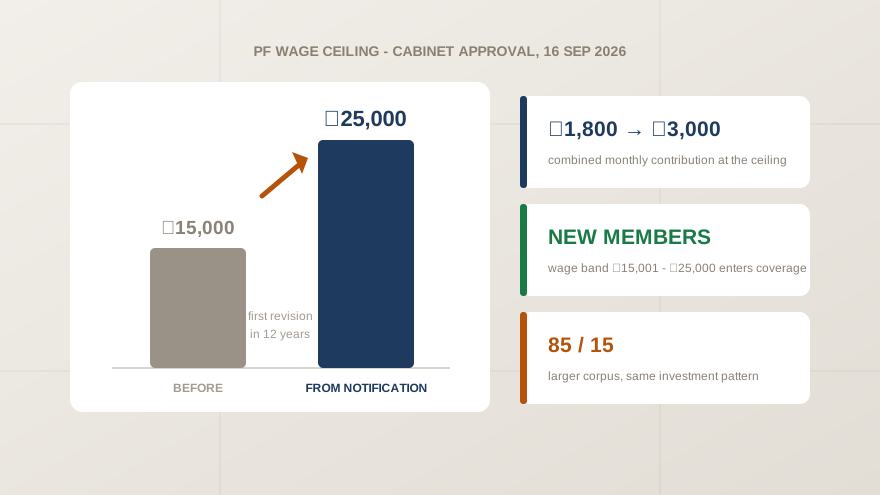
On 16 September 2026 the Union Cabinet approved raising the EPFO wage ceiling from ₹15,000 to ₹25,000 per month — the first revision in twelve years. National coverage put the numbers at roughly 51 lakh additional workers brought into mandatory coverage and an annual government outgo of about ₹11,339 crore. At the ceiling, combined employee and employer contribution moves from ₹1,800 to ₹3,000 per month.
Every mainstream article about this decision has been written for the employee: what happens to take-home pay, what happens to the retirement corpus. Almost nothing has been written for the finance controller of an EPFO-exempted establishment, who has to work out how many members the trust just inherited, what the incremental monthly liability is, and what a larger corpus does to the 85/15 allocation before the next board meeting.
That is what this article does. Note one important caveat throughout: the Cabinet has approved the revision, and the operative date and mechanics follow the formal notification. Plan against the decision; execute against the gazette.
Who Actually Enters Coverage
The ceiling is the wage level up to which statutory contribution is mandatory. Raising it from ₹15,000 to ₹25,000 has two distinct effects on an exempted trust, and they are easy to conflate.
The first is new members. Employees whose wages sit between ₹15,001 and ₹25,000 and who were not previously mandatorily covered come into coverage. In a workforce with a large entry-grade or contract-converted population, this can be a material headcount addition to the trust in a single cycle — each one needing a member record, a UAN linkage, an opening balance, nomination details and a place in the interest computation.
The second is existing members whose contribution basis rises. A member earning ₹22,000 whose contribution was computed on a ₹15,000 basis now contributes on a higher basis. No new member record is created, but the monthly inflow per member increases — and so does the settlement and loan-entitlement arithmetic that flows from a larger balance.
A Worked Example
Take a trust with 1,400 members today. Assume 180 employees earn between ₹15,001 and ₹25,000 and were not previously covered, and that 500 existing members earn above ₹15,000 and were contributing on the old ceiling basis.
On the new members: 180 employees at the ceiling contribute ₹3,000 a month combined, or ₹5.4 lakh a month — roughly ₹64.8 lakh a year of new inflow, and 180 new member records to open, maintain and report on. On the existing members whose basis rises: 500 members moving from a ₹1,800 combined contribution to ₹3,000 adds ₹1,200 each, ₹6 lakh a month, ₹72 lakh a year.
Together that is on the order of ₹1.37 crore of additional annual contribution inflow and a member base up by 13 per cent. Both numbers matter, but they matter to different people: the headcount is an administration problem, the inflow is an investment problem. Your own figures will differ — the point of the exercise is that they can be computed from your existing wage register in an afternoon, and should be, before the board asks.
The Knock-On Effects Nobody Has Costed
A larger corpus has to be invested in compliance with the pattern of investment. New inflow of the order above has to be deployed across the 85 per cent prescribed-instrument allocation and the balance, on a schedule, without breaching the norm in the interim. Where the trust has been running close to the allocation boundary, a step-change in inflow is exactly the condition under which a drift becomes a violation. Our guide to 85/15 investment norm compliance sets out the discipline; note also that from 10 September 2026 EPF exempted establishments may invest in rupee bonds of the New Development Bank, which widens the deployment options slightly.
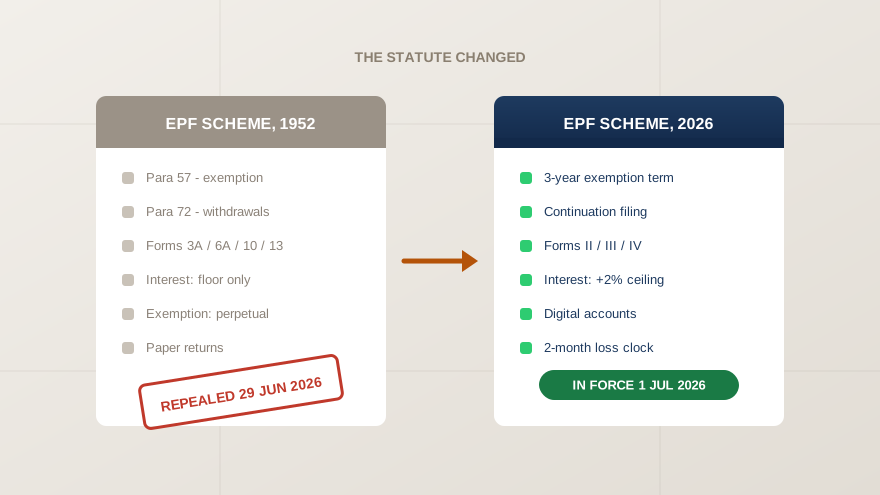
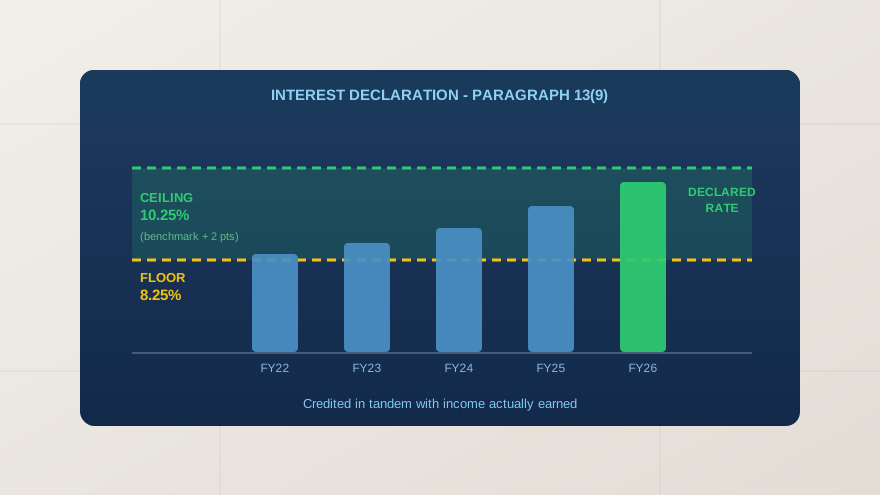
A larger corpus also interacts with the new interest regime. Under the EPF Scheme, 2026 the declared rate must track income actually earned and is capped at two percentage points above the statutory benchmark, declared annually by the Board under paragraph 13(9). Deploying a large tranche of new money at prevailing yields changes the blended income on which that declaration rests — see the new 2 per cent interest ceiling.
Then there is the administrative tail: EDLI and pension-scheme knock-ons for newly covered members, member statements now due within two months of financial-year close for a larger population, and the employee self-service load that comes with several hundred new members who have questions. On the employer-contribution side, note that under the 2026 Scheme matching above the statutory ceiling is no longer mandatory, while the anti-avoidance rule against cosmetic salary restructuring remains fully applicable — so the ceiling decision should not be read as an invitation to re-cut wage structures.
What the Finance Controller Should Table
Bring four numbers to the next board or management meeting. One: additional members entering coverage, from the wage register. Two: incremental monthly and annualised contribution liability, split between new members and re-based existing members. Three: the resulting corpus growth and the deployment plan that keeps the pattern of investment intact. Four: the administrative load — records to create, statements to issue, settlements and loans to service at higher balances.
Add one sentence on systems capacity, honestly assessed. Onboarding several hundred members, recomputing interest across a changed contribution basis mid-year and issuing statements to a larger population within two months of year end is not a spreadsheet exercise at scale. If your trust's answer to a 13 per cent membership increase is to add rows to a workbook, that is the finding to table.
Sizing the Impact on Your Own Numbers
The ceiling revision is, unusually, a change with a knowable answer. Your wage register already contains everything needed to compute the member and liability impact precisely, and the earlier that computation exists, the less of it happens under pressure after the notification lands.
MyPF Software manages member and contribution records, auto-computes monthly interest, tracks the investment portfolio against the 85/15 norm and issues member statements and self-service access at scale — which is what turns a ceiling revision into a configuration change rather than a quarter of remediation. Book a 30-minute session and we will size the impact against your own member data, or start with our EPF Scheme 2026 vs 1952 comparison for the wider regime.
To see the arithmetic on your own member base before that meeting, our wage ceiling impact calculator works it out in about a minute, with no signup.
Ready to simplify your PF trust compliance?
MyPF Software helps exempted PF trusts stay inspection-ready, automate filings, and manage investments — all in one platform built for India.