Table of Contents
From a Floor to a Corridor
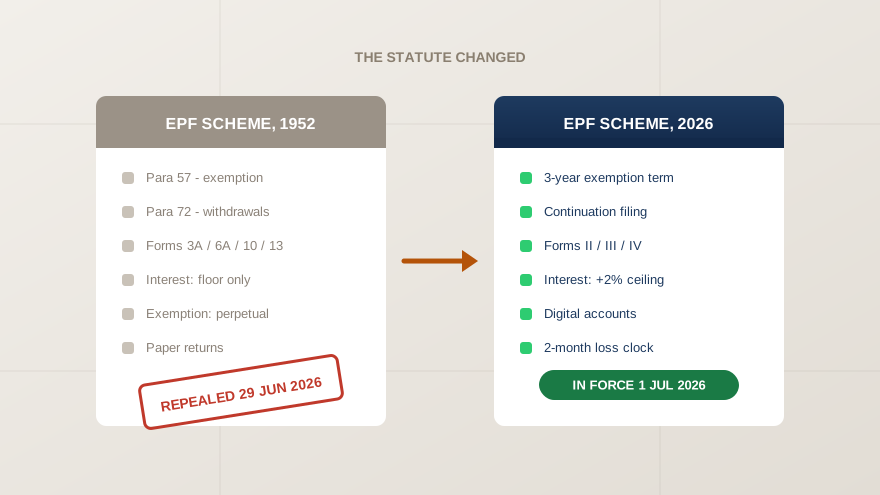
For decades, the interest obligation on an EPFO-exempted provident fund trust was a floor. The trust had to credit members at a rate not lower than the rate declared by the Central Government for the statutory Scheme — 8.25 per cent for FY 2025-26, as held by the Central Board of Trustees. Anything above that floor was the trust's own affair, and for a well-run corpus it was a selling point to members and a source of institutional pride.
The Employees' Provident Funds Scheme, 2026 replaced that floor with a corridor. Interest must now be credited in tandem with the income the trust has actually earned during the year, and the declared rate is capped at two percentage points above the statutory benchmark rate. The PF trust interest rate ceiling is the single most direct constraint the 2026 Scheme places on a trustee board's discretion, and ET Now characterised it plainly: the new norms tighten oversight of exempted trusts by capping the declared rate.
What Paragraph 13(9) Actually Requires
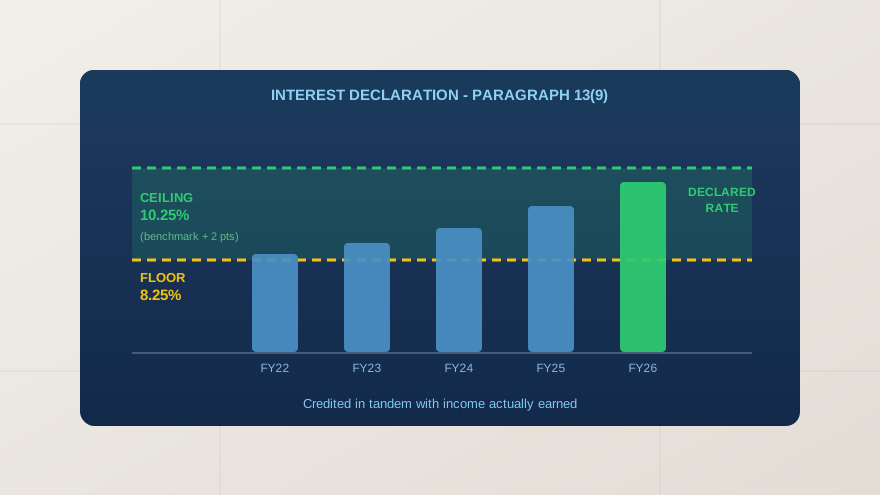
Paragraph 13(9) of the 2026 Scheme requires the Board of Trustees to declare the interest rate annually, commensurate with the income earned by the trust during the year. Two words in that sentence do most of the work. "Annually" makes the declaration a scheduled governance act with a minuted decision behind it, not a carried-forward convention. "Commensurate" ties the number to realised income rather than to what the board would like to announce.
Read together with the two-percentage-point cap, the rule produces a bounded decision. The floor is still the statutory benchmark. The ceiling is benchmark plus two points. And within that corridor, the board must be able to show that the declared rate is supported by the income the trust actually earned — interest, coupon, accretion and realised gains on the corpus for the year in question.
The practical burden lands on evidence, not on judgement. A board that declares a rate it can justify but cannot document is in the same position at inspection as a board that declared the wrong number. Lakshmikumaran & Sridharan wrote this up on 11 September 2026 as part of a broader argument that exempt trust rules drafted under the 1952 Scheme now need amendment to match the new declaration mechanics.
The Arithmetic, With Numbers
Take a trust with a corpus of ₹180 crore and a statutory benchmark of 8.25 per cent. The floor for the year is 8.25 per cent. The ceiling is 10.25 per cent. Suppose the trust earned income of ₹16.2 crore on average assets under management of ₹180 crore — a realised yield of 9.0 per cent. The board may declare up to 9.0 per cent, subject to the corridor, and must be able to reconcile the declaration to that income.
Now change one input. Suppose the same trust earned only ₹14.0 crore — a realised yield of 7.78 per cent, below the statutory benchmark. The floor still binds: the trust must credit at least 8.25 per cent. The shortfall between what the trust earned and what it must credit has to be met from reserves or by the employer. This is where an interest shortfall becomes a Category A exposure under the October 2023 SOP, which our guide to SOP violation categories A, B and C sets out in full.
The third case is the one boards like least. Suppose the trust earned ₹21.6 crore — a realised yield of 12.0 per cent, comfortably above the corridor. The board may declare no more than 10.25 per cent. The excess does not disappear; it stays in the fund as surplus, and what happens to it becomes a governance question rather than a distribution decision.
The Surplus Question Nobody Is Asking
A corridor with a hard ceiling mechanically produces retained surplus in good years. EPFO has previously issued guidance on the utilisation of reserves and surplus in exempted PF trusts, and the topic is now considerably more live than it was, because the 2026 Scheme makes surplus accumulation a structural feature rather than an occasional accident.
Boards should decide, in advance and in writing, what the trust's policy on surplus is: whether it is held as a reserve against future shortfall years, whether it is used to smooth the declared rate within the corridor across a cycle, and what disclosure members receive about it. A documented surplus policy, minuted and reviewed annually, is a far better answer to an inspector's question than a retrospective explanation.
It is also worth noting what the ceiling does to the competitive logic of exemption. If a trust can no longer pass through its full outperformance, part of the historic case for maintaining an in-house trust weakens. That belongs in the CFO's stay-or-surrender analysis, which we reopen in re-running the maths after EPF Scheme 2026.
What the Declaration File Should Contain
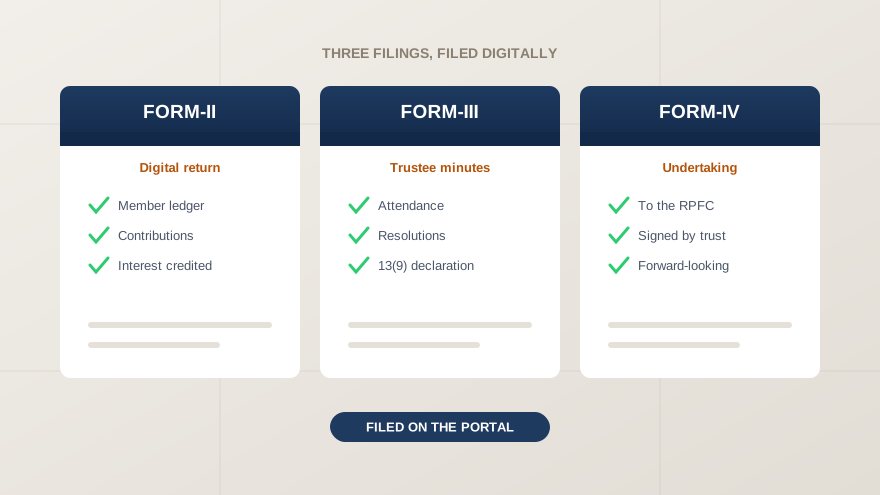
Build a standing interest-declaration file and populate it the same way every year. At minimum it should hold: the audited income statement of the trust for the year; a computation of realised yield on average assets under management, with the basis stated; the statutory benchmark rate for the year and its source; the corridor derived from it; the rate proposed to the board; and the Form-III minute recording the declaration and the reasoning behind it.
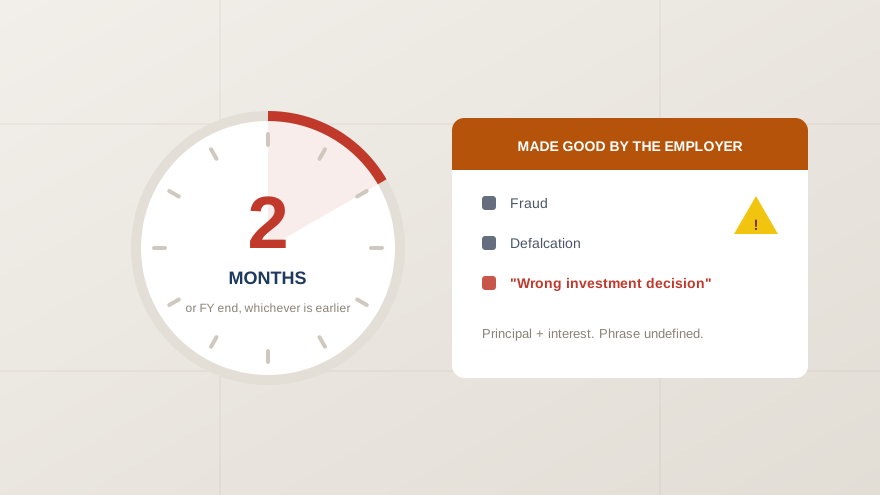
Add the member-communication leg, because the 2026 Scheme now requires it. Members must receive a statement of account within two months of financial-year close, and the PF Trust Rules must be circulated to them in the language of the majority. A declared rate that members learn about informally, months late, is a compliance gap even where the rate itself is correct.
Finally, keep the investment side of the file joined to the interest side. The income that justifies the declared rate comes from a portfolio that must simultaneously satisfy the 85/15 pattern of investment — and the investment universe itself is moving, with EPF exempted establishments permitted from 10 September 2026 to invest in rupee bonds of the New Development Bank.
Making the Declaration Defensible
The interest declaration is now the most scrutinised single decision a trustee board takes in the year. It has a statutory floor, a statutory ceiling, an income test, an annual cadence, a minuting requirement and a member-communication obligation attached to it. Very few trusts running on spreadsheets can evidence all six without a scramble.
MyPF Software computes member-level interest automatically against the declared rate, holds the investment income and portfolio position that supports it, and produces the trustee-meeting and member-statement outputs the 2026 Scheme expects — so the declaration file assembles itself as the year runs rather than in the week before the board meets. Request a demo and we will walk your finance team through a full declaration cycle, or start with the wider picture in our EPF Scheme 2026 guide for exempted trusts.
Ready to simplify your PF trust compliance?
MyPF Software helps exempted PF trusts stay inspection-ready, automate filings, and manage investments — all in one platform built for India.