Table of Contents
A Deadline Attached to an Undefined Phrase
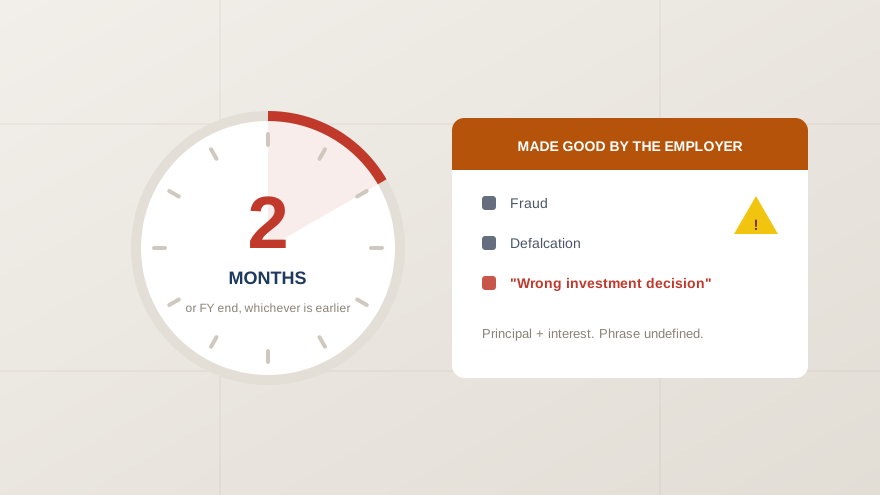
Buried in the Employees' Provident Funds Scheme, 2026 is a provision that should be on every trustee board's agenda and is on almost none. Losses to the fund arising from fraud, defalcation or a "wrong investment decision" must be made good by the employer — principal and interest — within two months of the loss, or by the end of the financial year, whichever is earlier.
Two things about that sentence deserve attention. The first is the clock: two months, or sooner if the financial year ends first. The second is the phrase "wrong investment decision", which the Scheme does not define. Willis Towers Watson flagged precisely this in its clause-by-clause review, observing that the line between the employer making good "losses" and making good "interest loss" appears blurred. As far as we can establish, no adviser or vendor has yet taken a clear position on what the phrase covers.
This article takes one. Not as legal advice — your counsel and your statutory auditor own that — but as a governance position a trustee board can act on while the interpretation settles.
What the Phrase Plausibly Covers, and What It Should Not
Fraud and defalcation are familiar categories with an established meaning; the change there is the timeline, not the concept. "Wrong investment decision" is the novel term, and it sits in uncomfortable proximity to ordinary market risk.
A narrow and, we would argue, correct reading is that the phrase attaches to decisions that were impermissible or unjustifiable at the moment they were taken — an investment outside the prescribed pattern of investment, an instrument outside the approved universe, a placement made without the mandated approval, a concentration that breached the trust's own investment policy, or a decision taken on inadequate diligence. On that reading, the test is process, not outcome.
A broad reading would sweep in any investment that subsequently lost money. That reading cannot be right as a matter of policy — it would make trustees underwriters of market movement and render the 85/15 framework, which deliberately permits a measured allocation to market instruments, incoherent. But a trust cannot rely on the narrow reading unless it can evidence the process. That is the whole practical point.
The Two-Month Clock Is the Real Problem
Set the interpretive question aside and look at the mechanics. A loss occurs. Two months later — or at financial-year end, if that comes first — it must have been made good, principal and interest, by the employer. Everything that has to happen in between is compressed into that window: identifying the loss, quantifying it, characterising it, taking it to the board, obtaining employer agreement to fund it, moving the money and recording the whole sequence.
For a trust that reconciles monthly and closes its books quickly, this is tight but workable. For a trust that discovers a valuation or reconciliation problem during the annual audit, it is already too late — the loss may have occurred nine months earlier, and the window may have closed before anyone knew there was a window. Detection latency, not liability, is the exposure most trusts actually carry here.
Note also who pays. The obligation to make good falls on the employer, which means the finance function is a party to the process from the first day, not a recipient of a trustee decision at the end of it. A trust whose books are opaque to its own sponsor cannot run this process in two months.
What Trustees Should Document Now
The defence against an undefined liability is a documented process. Five artefacts do most of the work, and all five can be in place inside a quarter.
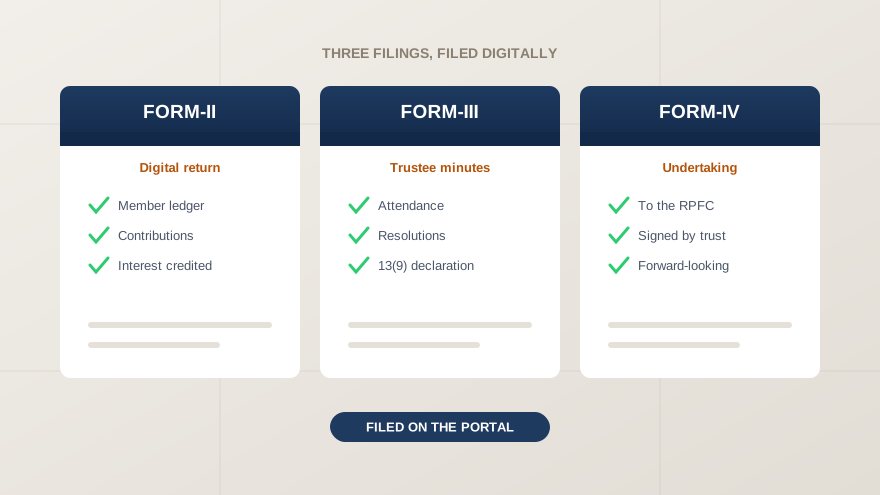
First, a written investment policy statement for the trust: the permitted universe, the pattern-of-investment allocation, concentration and counterparty limits, approval thresholds, and who may execute. Second, a decision record for every investment — what was bought, on whose recommendation, against which limit, with what diligence attached, approved by whom. Third, Form-III trustee minutes that show the decision being taken rather than merely reported, which our walkthrough of Form-II, Form-III and Form-IV covers in detail.
Fourth, a monthly reconciliation and valuation routine, so that a loss is discovered in weeks rather than at audit. Fifth, a written loss protocol agreed with the employer in advance: who is notified, how the loss is quantified and characterised, who authorises the recoupment, and how it is booked — so that when the two-month clock starts, nobody is inventing a process.
How This Interacts With the Rest of the 2026 Regime
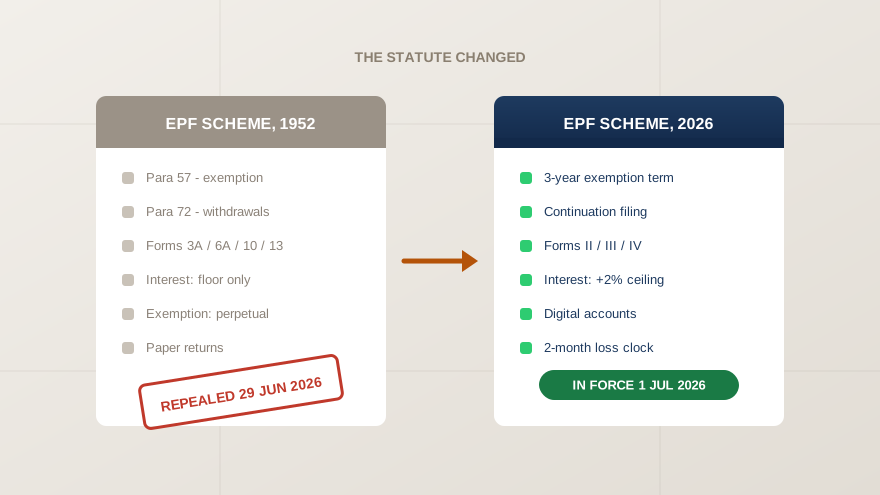
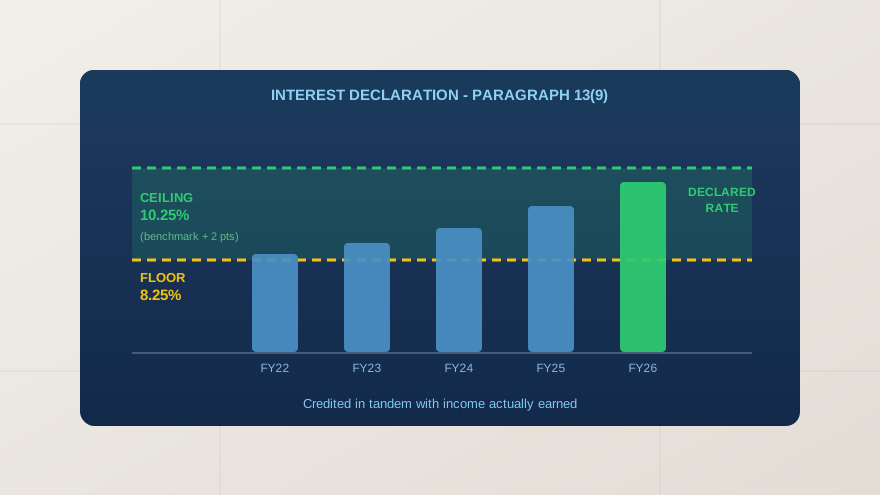
The loss provision does not sit alone. The 2026 Scheme also ties the declared interest rate to income actually earned, capped at two percentage points above the statutory benchmark, with an annual declaration by the Board under paragraph 13(9). A loss in the corpus therefore reaches members twice: once as a loss to be made good, and once as pressure on the rate the board can justify declaring. Our article on the new interest ceiling works through that arithmetic.
Exemption is also now a three-year term requiring continuation and renewal filings, with the continuation window for existing exempted establishments running from 8 May 2026. An unresolved loss, an unfunded recoupment or a thin decision trail is not just an audit finding in that context — it is evidence going into a renewal decision. Trustee exposure under the 2026 Scheme should be read alongside our existing analysis of trustee liability in India, which predates the new Scheme and should now be read together with this piece.
The Position We Would Take to a Board
Assume the broad reading might be argued against you, and make it unnecessary. If every investment decision carries a written mandate, a limit check, a diligence note and a minuted approval, then a loss that later occurs is demonstrably a market outcome rather than a wrong decision — and the conversation with EPFO is about evidence you already hold instead of an inference from silence.
MyPF Software keeps the trust's investment portfolio, pattern-of-investment position, maturity profile and decision trail in one system, alongside the member ledger and interest computation that a loss ultimately affects — so detection happens in the monthly cycle and the evidence exists before anyone asks for it. Book a 30-minute review with our team, or contact us to discuss your trust's current investment governance.
Ready to simplify your PF trust compliance?
MyPF Software helps exempted PF trusts stay inspection-ready, automate filings, and manage investments — all in one platform built for India.