Table of Contents
The Graduated Enforcement Framework in EPFO SOP 2023 Compliance
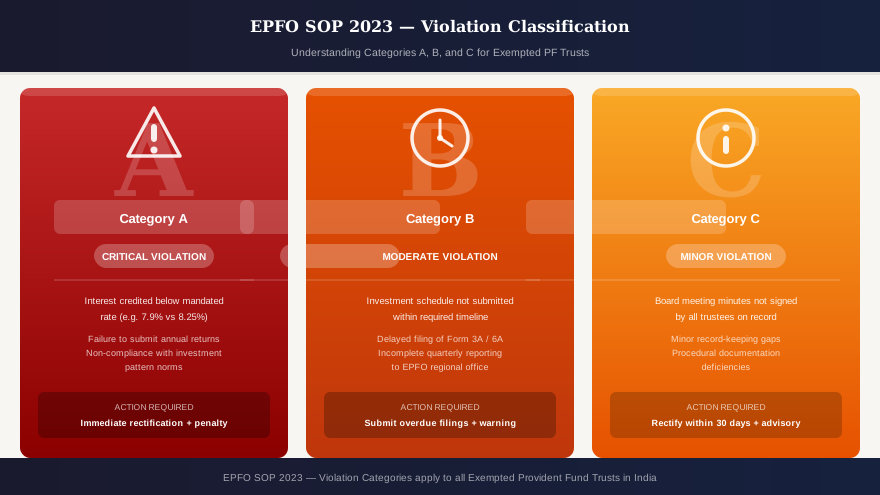
One of the most significant structural innovations in the October 2023 SOP is the introduction of a formal, graduated enforcement framework for EPFO SOP 2023 compliance. Rather than applying a uniform enforcement response to all inspection findings, the SOP classifies violations into Categories A, B, and C based on their severity, their direct and indirect impact on member interests, and the degree to which they undermine EPFO's regulatory oversight of exempted establishments. This categorisation determines the specific enforcement response — the nature of the notice, the remediation timeline, and the escalation pathway if corrective action is not taken.
For trust managers, understanding these categories is both a compliance necessity and a strategic tool. It is the framework that determines how urgently action must be taken when findings are made, and it is the lens through which self-assessment exercises — conducted before an inspection arrives — should be structured. For context on the full SOP and its implications across all aspects of trust management, see our comprehensive guide on EPFO SOP 2023 compliance for exempted PF trust managers.
Category A: Critical Violations and Immediate Enforcement
Category A violations under EPFO SOP 2023 compliance represent the most serious failures an exempted trust can commit — those that directly and materially harm member interests or fundamentally compromise the trust's legal standing as an exempted establishment. The defined Category A violations are: failure to credit the statutory minimum interest rate to member accounts for any financial year; investments in non-approved instruments that materially breach the 85% government securities requirement; and failure to constitute or validly maintain a Board of Trustees as required by the trust deed and EPF Rules.
A Category A finding triggers an immediate show-cause notice addressed to the trust. The remediation window under the SOP is a strict 60 days from the date of the notice — there is no provision for extension, and partial remediation does not satisfy the requirement. If the violation is not fully resolved within this 60-day period, EPFO initiates the formal process for cancellation of the trust's exemption status. This process involves a hearing before the Regional Provident Fund Commissioner, but the evidentiary and remediation burden rests entirely on the trust.
Repeat Category A findings — the same violation identified in two consecutive inspection cycles — are treated as the most serious escalation category and can result in expedited cancellation proceedings and personal enforcement action against individual trustees.
Category B: Significant Violations and Structured Remediation
Category B violations under EPFO SOP 2023 compliance are serious governance and compliance failures that do not rise to the immediate threat level of Category A, but which indicate systemic weaknesses in how the trust is managed. Defined Category B violations include: delayed filing of annual returns beyond 90 days after the statutory deadline; incomplete or unsigned Board of Trustee meeting records for any required meeting during the inspection period; minor investment deviations that do not materially breach the 85% threshold but indicate a lapse in monitoring; and material discrepancies between payroll contribution data and the trust ledger.
Category B findings result in a formal show-cause notice with a 90-day remediation window. The EPFO regional office will schedule a follow-up review at the next inspection cycle to verify that the finding has been fully resolved and that the underlying process failure has been addressed. Multiple Category B violations within the same inspection report, or the identical Category B violation appearing in two consecutive inspection reports, may be escalated to Category A at the inspecting officer's discretion.
Category C: Minor Violations and Continuous Improvement
Category C covers procedural and administrative lapses that do not directly impact member interests or the trust's fundamental compliance status. Examples include: filing the annual return within 90 days of the deadline but after the due date; minor member data discrepancies that do not affect calculated balances or interest crediting; submission packages that omit a non-critical supporting document (which can be filed separately); and administrative EPFO correspondence that was not responded to within the standard 30-day window.
Category C findings do not generate a formal show-cause notice. They are recorded in the inspection report with an expectation of resolution before the next inspection cycle. However, treating Category C violations as inconsequential carries its own risk: three or more Category C findings within the same inspection report may be aggregated and re-classified as a Category B violation. Category C findings that recur without remediation across inspection cycles are treated as evidence of a systemic compliance culture deficiency.
For detailed guidance on preventing the most common violations found during an EPFO audit, see our practical guide on 5 things EPFO can do during an exempted PF trust audit in India. Contact the MyPF Software team for assistance.
Ready to simplify your PF trust compliance?
MyPF Software helps exempted PF trusts stay inspection-ready, automate filings, and manage investments — all in one platform built for India.