Table of Contents
- 1. Why Exempted PF Trust Audits in India Are Intensifying
- 2. 1. Issue a Show-Cause Notice for Interest Rate Shortfall
- 3. 2. Flag Investment Non-Compliance and Direct Liquidation
- 4. 3. Demand Outstanding Filings and Back-Returns
- 5. 4. Review and Challenge Trustee Meeting Records
- 6. 5. Recommend Cancellation of Exemption Status
Why Exempted PF Trust Audits in India Are Intensifying
Following the October 2023 Standard Operating Procedure, EPFO's inspection machinery has been significantly strengthened and systematised. An exempted PF trust audit in India today is a structured, documentation-intensive exercise that goes far beyond a cursory review of contribution challans and member records. EPFO field officers now arrive with detailed inspection checklists derived directly from the SOP, cross-reference filed returns against internal trust records, and flag discrepancies with legal precision and defined escalation pathways.
For trust managers and trustees who have not updated their compliance practices since the SOP was issued, the gap between what EPFO inspectors expect and what most exempted trusts actually maintain can be very substantial. Understanding exactly what an inspector can do — and what conditions trigger each type of enforcement action — is the single most practical starting point for building an inspection-ready trust. The five actions described below represent the overwhelming majority of adverse outcomes reported by exempted establishments following audits across India.
1. Issue a Show-Cause Notice for Interest Rate Shortfall
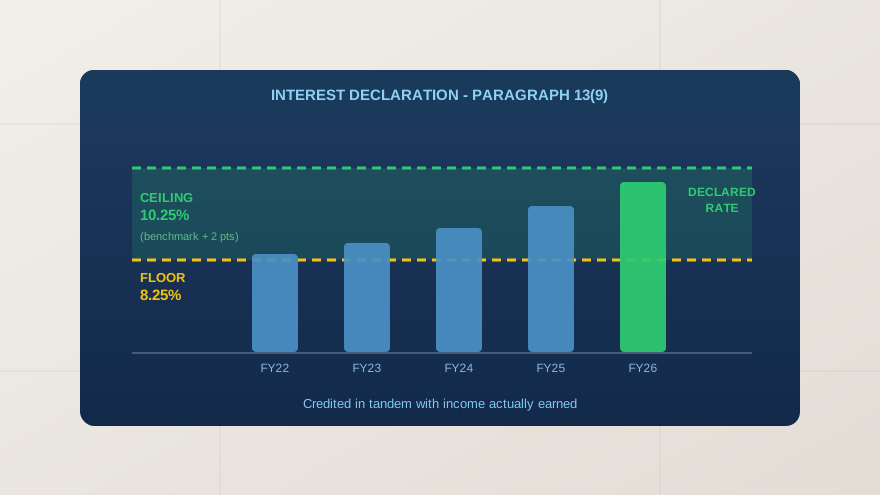
The most common adverse outcome from an exempted PF trust audit in India is a formal show-cause notice for failure to credit the statutory minimum interest rate. If your trust has credited even a fraction below the EPFO-declared rate for any financial year — currently 8.25% for FY 2024-25 — the inspector will issue a notice requiring you to make good the shortfall, together with penal interest calculated on the delayed crediting. This notice is issued regardless of whether the shortfall resulted from an investment decision, a calculation error, or an administrative oversight.
Trusts that rely entirely on investment returns to fund their interest crediting are particularly exposed in years of low portfolio yield. EPFO does not accept investment performance as a mitigating factor — the obligation to credit the statutory rate is absolute and unconditional under the EPF Act.
Prevention: Maintain a dedicated interest reserve fund within your trust corpus, sufficient to cover the statutory crediting obligation even in a below-average investment year. Credit the declared rate to member accounts promptly — ideally within 30 days of EPFO's annual announcement — rather than waiting for year-end reconciliation. Use compliance software that automatically computes the interest crediting requirement for every active member account, eliminating computational errors that frequently trigger shortfall notices.
2. Flag Investment Non-Compliance and Direct Liquidation
During an exempted PF trust audit in India, the inspector will request your complete investment schedule and verify each holding against the approved instruments list under the Pattern of Investment. Any investment in a non-approved instrument — regardless of its credit rating, maturity, or investment rationale — will be flagged as a violation. Depending on the quantum of the breach as a proportion of total corpus, this may be classified as a Category A or Category B finding, with a directed timeline to liquidate the non-compliant holding and reinvest in approved instruments.
For a full understanding of how the EPFO SOP 2023 compliance framework classifies and addresses investment violations, including the enforcement timelines that apply to each category, refer to our complete guide on the October 2023 SOP.
Prevention: Maintain a real-time investment tracker that continuously computes your 85% government securities allocation. Before executing any new investment, conduct a pre-investment compliance check verifying that the instrument is on the current approved list — which can be revised through Ministry of Labour notifications without advance notice to individual trusts. Never assume that an instrument that was compliant at the time of purchase remains so at the time of an inspection.
3. Demand Outstanding Filings and Back-Returns
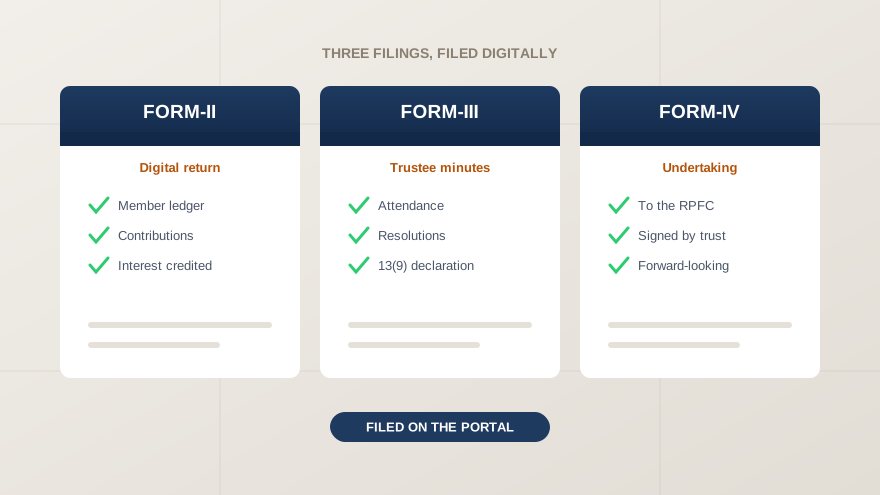
A significant proportion of adverse findings in an exempted PF trust audit in India relate directly to missing or delayed filings. Annual returns, quarterly investment statements, and member-wise contribution data are all reviewed during inspection. If any return is absent — even for a period several financial years prior — the inspector will formally note the default and, depending on the duration of the delay, may escalate it to a show-cause notice or a Category B violation finding.
For comprehensive guidance on the annual return filing process for the current financial year, see our step-by-step annual return filing guide for FY 2025-26, which covers data preparation, form completion, and submission requirements in full.
Prevention: Maintain a compliance calendar that tracks every filing deadline — annual returns, quarterly investment statements, and any EPFO regional office-specific requirements — with internal reminders set 30 days before each deadline. File all returns on time even if the underlying data requires subsequent correction. A filed-but-imperfect return is consistently treated more leniently than a missing one and significantly reduces your exposure during an audit.
4. Review and Challenge Trustee Meeting Records
The Board of Trustees is required to meet at least twice per financial year. During an exempted PF trust audit in India, inspectors will request the formal agenda, attendance sheets, and signed minutes for every meeting held during the inspection period. They specifically look for documented resolutions on interest rate declarations, investment decisions, and responses to EPFO communications. Missing minutes, documents lacking trustee signatures, or meetings that cannot be substantiated with contemporaneous evidence will be flagged as Category B compliance deficiencies.
Prevention: Standardise the trustee meeting process with a fixed template for agendas, attendance registers, and resolution records. Ensure every trustee signs the attendance register and approved minutes before the records are filed. Store all board governance documents in a centralised system — whether physical or digital — organised by financial year and meeting date for immediate retrieval during an inspection.
5. Recommend Cancellation of Exemption Status
The most severe outcome of an exempted PF trust audit in India is a formal recommendation by the inspecting officer to cancel the establishment's exemption status. This outcome is reserved for trusts with persistent Category A violations — sustained multi-year interest shortfalls, material and ongoing investment non-compliance, or a complete breakdown in trustee governance and documentation. The cancellation process involves a formal hearing before the Regional Provident Fund Commissioner, but the evidentiary burden falls heavily on the trust to demonstrate that the violations have been fully remediated.
Cancellation means all member PF accounts must be migrated to EPFO — a disruptive, time-consuming, and administratively demanding process that carries significant employer reputation risk with employees. Once an exemption is cancelled, reinstatement is extremely difficult and rarely granted.
Prevention: The most effective prevention strategy is a culture of proactive compliance — not reactive remediation. Address every EPFO notice within the prescribed timeline, without exception. Never allow a show-cause response to lapse. Invest in proper compliance infrastructure — sound governance, purpose-built software, and trained personnel — before you receive an inspection notice, not after one arrives. Contact us to learn how MyPF Software assists exempted trusts across India in maintaining year-round inspection readiness.
Ready to simplify your PF trust compliance?
MyPF Software helps exempted PF trusts stay inspection-ready, automate filings, and manage investments — all in one platform built for India.