Table of Contents
The Complaint, in the Member's Own Words
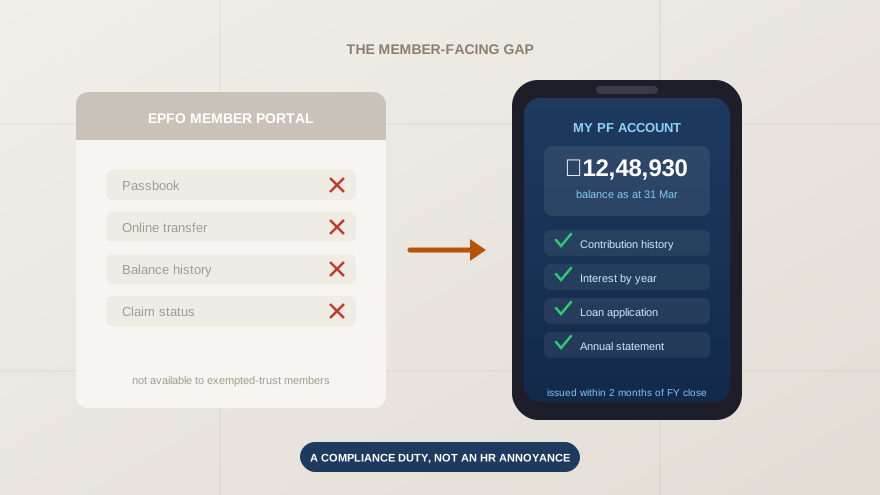
On r/epfoindia there is a thread titled, more or less verbatim, "Exempted PF trust confusion: no passbook, no transfer." Members of exempted establishments describe the same two frustrations repeatedly. They cannot see their provident fund balance on the EPFO portal the way colleagues at unexempted employers can. And when they change jobs, they cannot complete a transfer online — the process routes through the trust, on paper, on the trust's timetable.
India's HR practitioner forums carry the professional version of the same complaint, particularly around pension service-history transfers out of an exempted trust. Google's people-also-ask panel asks it directly: how do I transfer PF from an exempted establishment to an unexempted establishment?
For years this has been filed under employee-relations irritation — real, but not urgent. The Employees' Provident Funds Scheme, 2026 changes that classification, and this article is about why.
Why the Gap Exists
It is worth being fair about the cause. An exempted establishment administers its own provident fund; the member-level accounting lives with the trust, not with EPFO. The EPFO passbook service shows what EPFO accounts for, and for an exempted trust's members that is a partial picture at best. The gap is structural, not negligent.
But structure explains the gap; it does not discharge the duty. The long-standing condition of exemption is that the benefits the trust provides are at least as favourable as those under the statutory Scheme. As EPFO's own member-facing digital services have improved — passbook, online transfer, unified member portal — the practical experience of being a member has become part of what "as favourable" means in the eyes of the people it is measured for. A member who cannot see a balance their neighbour can see does not experience the arrangement as more favourable.
What the 2026 Scheme Turned Into an Obligation
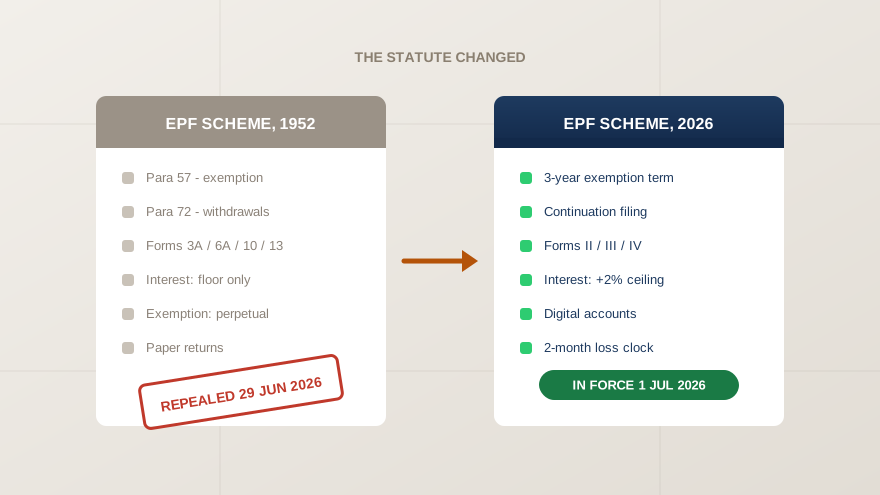
Three provisions of the 2026 Scheme move this from service quality to compliance. Trust accounts must be maintained digitally. The PF Trust Rules must be circulated to members and translated into the language of the majority of them. And each member must be issued a statement of account within two months of the close of the financial year.
Read those together and the direction is unmistakable: the Scheme now expects an exempted trust to be able to tell every member, digitally and promptly, where they stand. A trust that generates member statements by mail-merging a workbook in the fourth month after year end is not meeting the two-month obligation, and no amount of goodwill in the HR team fixes that at scale.
The withdrawal framework adds to the load. The 2026 Scheme collapses thirteen withdrawal categories into three — Essential Needs, Housing and Special Circumstances — permits up to 100 per cent of the eligible balance subject to a 25 per cent minimum retention, and extends the unemployment waiting period for full withdrawal to twelve months. Members will read about these changes in the national press and bring them to the trust. A trust that cannot show a member their eligible balance cannot have that conversation efficiently, and our trust rules amendment checklist covers implementing the new categories properly.
The Cost of the Gap, Counted Honestly
Quantify it and the case usually makes itself. Count the member queries your PF team handles in a month that consist entirely of "what is my balance" and "where is my transfer". Multiply by the handling time. Add the settlement and transfer turnaround time, which is the number members actually judge the trust by. Add the escalations that reach HR leadership, and the ones that reach the trustees.
Then add the compliance layer the 2026 Scheme created: the effort of producing statements for every member within two months of year end, and of evidencing that trust rules were circulated in the right language. In most trusts, the annual cost of the manual version of all this is a larger number than anyone has previously totalled, precisely because it is distributed across people whose job description is something else.
There is also a member-base effect arriving now. The Union Cabinet approved raising the wage ceiling from ₹15,000 to ₹25,000 on 16 September 2026, which brings a new cohort of members into coverage — each one a new record, a new statement and a new set of questions. We size that impact in how many members did your trust just inherit.
What Good Looks Like
A member of an exempted trust should be able to log in — on a phone, not only on a desk machine — and see their current balance, their contribution history, interest credited by year, their loan and withdrawal history, and their nomination details. They should be able to raise a loan or withdrawal application and see its status without emailing anyone. They should receive their annual statement automatically, within the two-month window, without asking for it.
On the trust's side, the same system should make the transfer and settlement process trackable: a request with a date, an owner, a status and an audit trail, so that when a member asks where their transfer is, the answer is a fact rather than a promise to check. This is exactly what the MyPF Software employee self-service portal and settlement workflow are built to do, alongside the member ledger and statutory reporting the trust runs on.
The governance argument is the one to take to your trustees, because it is the one that gets funded: under the 2026 Scheme, member communication is a stated duty with a deadline attached, and self-service is the only version of it that scales. Book a 30-minute demo to see the member portal against your own data, or read our EPF Scheme 2026 vs 1952 comparison for the full set of new obligations.
Ready to simplify your PF trust compliance?
MyPF Software helps exempted PF trusts stay inspection-ready, automate filings, and manage investments — all in one platform built for India.