Table of Contents
A Crisis Provision, Written Down This Time
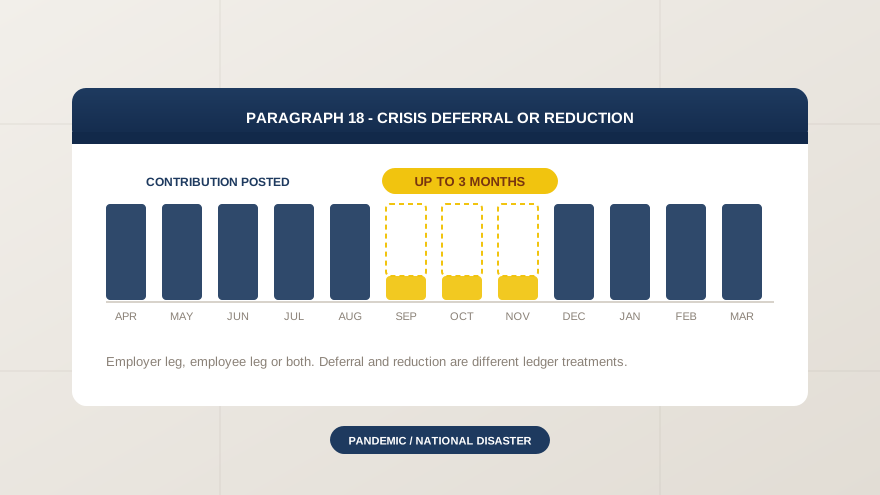
Between 15 and 17 September 2026, national outlets picked up a provision of the Employees' Provident Funds Scheme, 2026 that had gone largely unremarked at notification: paragraph 18 permits the Central Government to defer or reduce the employer's contribution, the employee's contribution, or both, for a period of up to three months, in circumstances including a pandemic, an endemic or a national disaster.
Anyone who administered provident fund during 2020 will recognise the shape of this. The contribution rate was temporarily reduced then too, under emergency notification, and payroll and trust teams implemented it at short notice with limited guidance. The difference now is that the power is written into the Scheme as a standing provision rather than improvised — which means the sensible time to work out your operating response is a quiet week, not the week it happens.
The employee-facing analysis has been done thoroughly: a lower contribution for three months means a smaller corpus and a compounding effect over a career. The question nobody has answered is the operational one. What does an exempted trust actually do for those three months, and for the year that contains them?
What Changes in the Member Ledger
Start with the distinction the notification will draw, because everything follows from it. A deferral means the contribution is still owed but paid later. A reduction means a lower contribution for the period. They produce entirely different ledger treatments, and a trust that conflates them will misstate member balances.
Under a reduction, the monthly contribution posted to each member for the affected months is lower, and the member's balance grows more slowly. Under a deferral, there is a receivable: the contribution relating to those months arrives later, and the trust has to track which months each payment relates to rather than simply crediting it on receipt. If a member settles, transfers out or takes a loan during the deferral period, the entitlement computation has to reflect a balance that is genuinely incomplete.
Three further details bite. Employer and employee legs may be treated differently, so the ledger must handle an asymmetric change. Interest accrues on balances that are lower or arriving late, which affects the year's computation member by member. And the change has a start and end date mid-year, so the contribution basis is not uniform across the financial year — which every downstream report has to respect.
What Changes in Interest Accrual
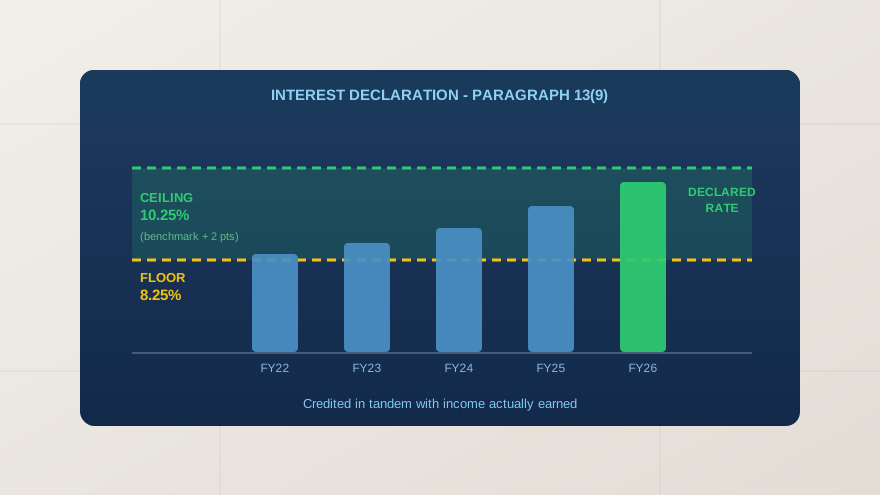
Under the 2026 Scheme the declared rate must track the income the trust actually earned, capped at two percentage points above the statutory benchmark, and the Board declares it annually under paragraph 13(9). A three-month contribution reduction reaches that declaration from both sides.
On the asset side, lower inflow means less new money deployed during the period, which changes the blended yield on the corpus for the year. On the liability side, member balances are lower for part of the year, so the interest credited in absolute terms falls. Neither effect is difficult; both are impossible to get right retrospectively if the ledger did not record what changed and when.
There is also a fairness dimension the Board should minute. Members who joined, left or settled during the affected months experience the change unevenly. A documented decision about how the interest computation handles the period — taken in advance and recorded in Form-III — is worth far more than an explanation constructed for an inspector two years later. Our article on the interest ceiling and the annual declaration sets out what that declaration file should contain.
What Changes in Member Communication
The 2026 Scheme requires each member to receive a statement of account within two months of the close of the financial year, and the PF Trust Rules to be circulated to members in the language of the majority. A year containing a contribution reduction is precisely the year in which members read their statement carefully and come back with questions.
Plan the communication rather than waiting for the queries. Members need to know which months were affected, what the change was, whether it was a deferral or a reduction, what it did to their balance and their interest, and — if it was a deferral — when the missing contributions arrived. An exempted trust has an advantage here over the statutory route if it chooses to use it: it knows its members and can tell them directly. It also has a disadvantage, which is that members of exempted trusts cannot check the position for themselves on the EPFO portal, a structural gap we examine in no passbook, no transfer.
A Three-Page Standing Playbook
Write this once and file it with your governance documents. Page one: triggers and roles. Who monitors for the notification, who reads it, who decides the trust's implementation, and by when. Page two: the ledger treatment, specified for both cases — reduction and deferral — including the receivable tracking, the interest-accrual approach, and how settlements, transfers and loans during the period are computed. Page three: the communication plan, including what goes to members, when, and in which language.
Then test the assumption underneath all three pages: can your system actually post a different contribution basis for a defined three-month window, track deferred contributions by the month they relate to, and compute interest correctly across a mid-year basis change? If the honest answer is that somebody would handle it manually in a workbook, the playbook is not implementable, and you have found a more important problem than paragraph 18.
MyPF Software handles contribution-basis changes, deferred and back-dated contributions, and automatic monthly interest computation across a changed basis, with member statements and self-service generated from the same ledger — which is what makes a three-month emergency an adjustment instead of a reconstruction. Book a demo or read our EPF Scheme 2026 guide for exempted trusts.
Ready to simplify your PF trust compliance?
MyPF Software helps exempted PF trusts stay inspection-ready, automate filings, and manage investments — all in one platform built for India.