Table of Contents
A Dated Window, and a Real Discount
Section 14B of the Employees' Provident Funds and Miscellaneous Provisions Act is the provision under which EPFO levies damages for delayed remittance of contributions. Most finance functions with any operating history in India carry some 14B exposure: a delayed challan during a systems migration, a dispute over the wage base, an adjudication that was contested and never closed, an assessment that was raised and never paid.
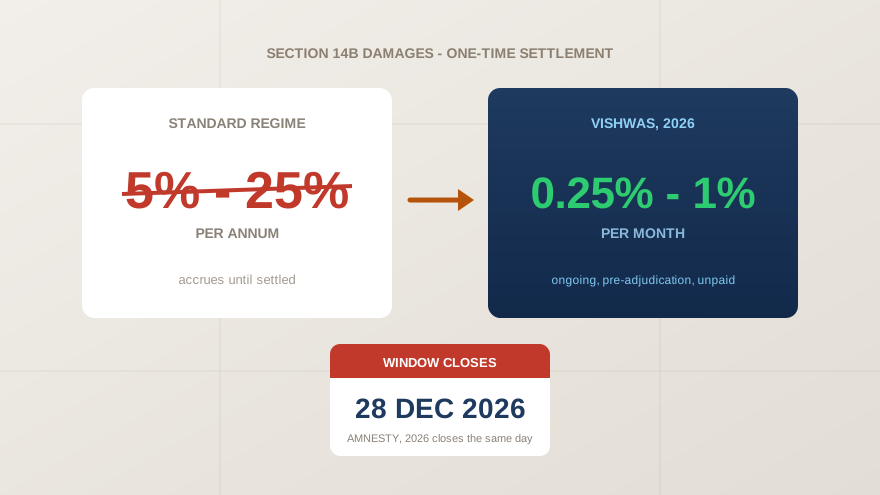
VISHWAS, 2026 is EPFO's one-time settlement route for exactly that backlog. Damages are computed at 0.25 per cent to 1 per cent per month under the scheme, against the standard 5 per cent to 25 per cent per annum regime. The window closes on 28 December 2026. EPFO has been running regional awareness seminars — Chandigarh and Cuttack among them — and pushing the scheme through PIB releases and its WhatsApp channel, because uptake, not awareness, is the constraint.
Our compliance page already names Section 14B as an exposure exempted establishments carry. VISHWAS, 2026 is the part of that thought that finance heads can act on this quarter.
Who Is Eligible
The scheme is aimed at the full spread of live 14B exposure rather than at one narrow category. On EPFO's framing it covers cases that are ongoing, cases that are at the pre-adjudication stage, and assessed damages that remain unpaid. In other words: whether your exposure is an argument, a notice or a liability sitting on the balance sheet, there is a route through the scheme for it.
Application is online. The practical eligibility question for most establishments is therefore not legal but informational — knowing the complete inventory of 14B matters across every establishment code the group operates. Organisations with multiple locations, legacy entities from acquisitions, or registrations that changed hands during a restructuring routinely discover exposure nobody had logged centrally.
Exempted establishments are not outside this. Running an in-house provident fund trust does not remove the obligation to remit on time or the consequences of not having done so, and a trust that migrated between administrators or systems in the past decade is a common place for a delayed-remittance episode to hide.
The Arithmetic, With an Example
The difference between the two regimes compounds with time, which is why old exposure benefits most. Consider a delayed remittance of ₹40 lakh that has been outstanding for 30 months and falls into a band attracting damages at 25 per cent per annum. Under the standard regime the damages accrue at roughly ₹10 lakh a year — on the order of ₹25 lakh over the two and a half years.
Settled under VISHWAS, 2026 at 1 per cent per month, the same 30-month exposure computes at roughly 30 per cent of principal — about ₹12 lakh. At the lower end of the scheme band, 0.25 per cent per month, the figure is closer to ₹3 lakh. The precise number depends on the band that applies to the case and the period involved, and should be computed case by case rather than from an illustration; the point is the order of magnitude of the difference.
Set against that the cost of doing nothing. Damages under the standard regime continue to accrue, contested matters continue to consume legal and finance time, and the provision sits on the balance sheet through every audit. For a CFO, VISHWAS, 2026 is a rare opportunity to convert an open-ended accrual into a closed, quantified number before a fixed date.
AMNESTY, 2026: The Other Scheme Closing the Same Day
VISHWAS, 2026 shares its 28 December 2026 deadline with AMNESTY, 2026, and the two are frequently confused. They address different problems. VISHWAS settles damages. AMNESTY regularises exemption status.
AMNESTY, 2026 is a one-time regularisation route for bodies that have Income-Tax recognition for their provident fund but no formal exemption order under Section 17 or Section 143 — a population that has been administering a PF trust for years without the statutory status to match. The scheme waives the usual minimum employee strength, corpus size and three-year compliance record requirements, allows retrospective regularisation, and leaves the establishment free afterwards to remain exempt or move to unexempted status. Applications follow EPFO's circular of 11 July 2026.
EPFO has said it expects around 105 trusts to apply, and is working through ICAI and the Income Tax Department to identify them — which is a strong hint that if your PF trust's exemption paperwork has ever been described internally as "historical" or "with the auditors", this is the year to establish exactly what status you hold. A third scheme, the Employees' Enrolment Campaign, 2026, runs on a different clock and closes on 31 October 2026.
A Four-Week Plan to the Deadline
Week one: build the inventory. Every establishment code, every open 14B notice, every adjudication in progress, every assessed-and-unpaid amount, every provision in the books. Include entities acquired, merged or renamed. The most common reason an organisation misses this window is that nobody held the complete list.
Week two: quantify both scenarios for each item — accrual under the standard regime versus computation under VISHWAS, 2026 — and identify which matters are contested on the merits, where settling may interact with a position you are defending. That is a conversation for counsel, not a spreadsheet decision.
Week three: take a board or management paper with a recommendation per item, and obtain funding approval. Week four: file online, with time in hand. A deadline of 28 December means a practical deadline in the first half of December, because EPFO offices and your own approvers will both be thinner in the last fortnight of the year.
Getting Your Records Ready Before You File
Both schemes reward an establishment that can produce clean records quickly: contribution histories by member and period, remittance dates against due dates, the trust's books for the years in question, and the correspondence trail with EPFO. Trusts running on spreadsheets typically spend the first two weeks of any such exercise rebuilding data that should have been queryable in an afternoon.
MyPF Software holds the member ledger, contribution and remittance history, statutory reports and EPFO correspondence in one place, which is what makes an exercise like this a reporting task rather than an archaeology project. If you are working toward the 28 December window and want your records in order first, book a 30-minute call or read our EPF Scheme 2026 guide for exempted trusts for the wider compliance picture.
One last check before 28 December: if your trust holds Income-Tax recognition but never obtained a formal exemption order, the AMNESTY, 2026 window closes on the same day, under a quite different eligibility test.
Ready to simplify your PF trust compliance?
MyPF Software helps exempted PF trusts stay inspection-ready, automate filings, and manage investments — all in one platform built for India.