Table of Contents
Every PF Trust Starts With Excel
Almost every PF trust begins the same way. A spreadsheet handles contributions, interest and withdrawals for a few hundred members. Then the member list grows, the rules change, and the spreadsheet becomes a fragile system nobody fully trusts.
The next step is usually a custom application built in-house. It feels like the logical answer, and on paper it looks cheaper. In practice, it is where most of the trouble begins. Finance and HR teams are right to ask the build question. For most trusts, the honest answer is that building is the costlier route, and the rest of this article shows why.
What an In-House Build Costs Over Three Years
The figures below are an illustrative model, not a quote and not a survey. They exist so your finance team can see where the money goes. Recalculate every line with your own salary bands before you rely on them.
The model assumes: a four-person build team (two senior engineers at ₹25 lakh CTC, two mid-level at ₹12 lakh) working for roughly nine months; a two-person maintenance team at an average ₹18.5 lakh CTC for years one to three; 20% employer on-costs; and about one replacement hire a year at roughly ₹5 lakh in recruitment cost.
Initial build: about ₹67 lakh. Maintenance team, three years: about ₹133 lakh. Recruiting and replacing leavers: about ₹15 lakh. Hosting, infrastructure and a security audit: about ₹12 lakh. Rule-change updates: about ₹15 lakh.
The total is about ₹2.4 crore over three years for a mid-sized trust, and most of it is people. Notice what the model leaves out: the opportunity cost of your finance and HR leads writing requirements instead of running the trust, and any penalty or rework when a build slips past a compliance date. Those are real, and they are not in the number.
Compliance Is the Real Pain Point
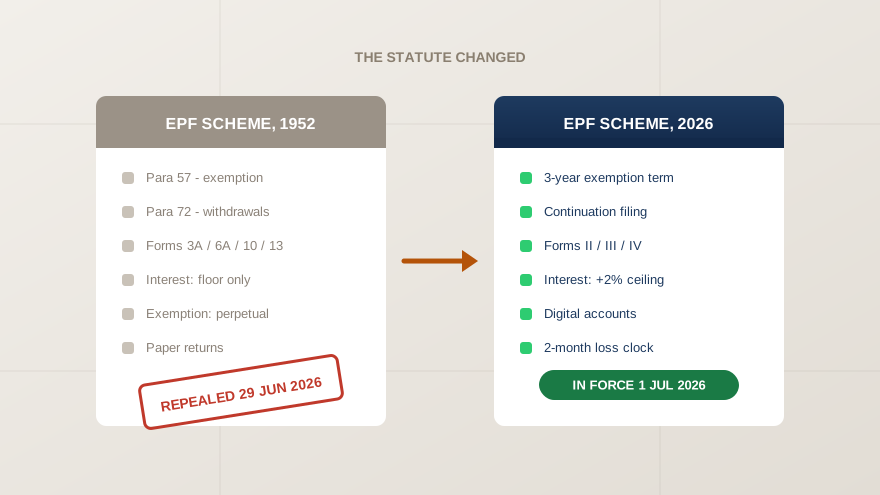
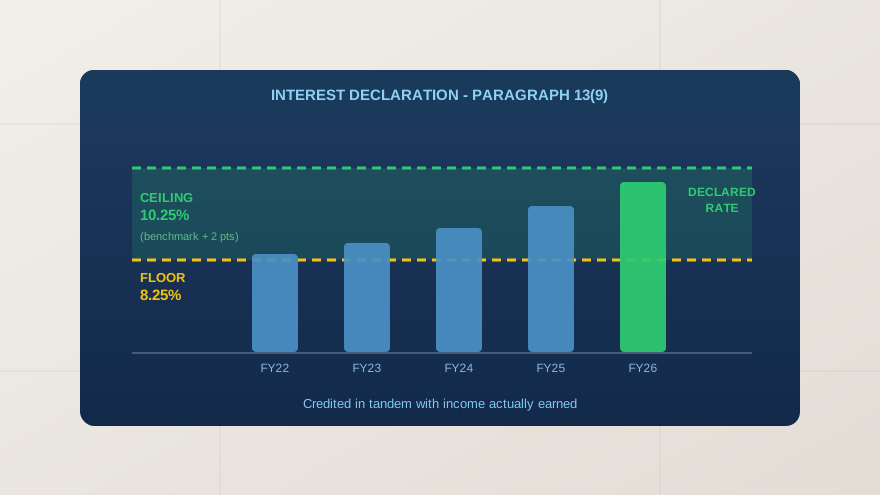
PF rules change on government timelines, not on yours. An application built for last year's rules becomes non-compliant the moment a new circular or form arrives. The EPF Scheme, 2026 is the current proof: exemption is now a three-year term, interest is capped at two percentage points above the statutory rate, and trusts must maintain accounts digitally and issue member statements within two months of the financial year closing. Our EPF Scheme 2026 vs 1952 comparison sets out the full list.
The cost of falling behind is not only a fine or a rejected filing. A system that cannot keep up stops calculating correctly, delays member services, and struggles to produce the reports your board and your members expect. Every calculation error lands in a member's retirement balance.
So the question is not whether the rules will change. It is who will update the system when they do, and how quickly.
The Retention Trap
A PF trust exists to manage retirement savings for its members. It is not a software company. Building in-house means hiring developers who must also understand payroll rules, statutory formulas and compliance deadlines. That is a narrow profile, and outside the technology sector it is hard to hold on to.
When the first hire leaves, the knowledge leaves with them. The next hire starts from scratch, and the application ages while the search continues. Each departure resets the clock on compliance. A trust that built its own system is one resignation away from an unmaintained one.
Build vs Buy, Factor by Factor
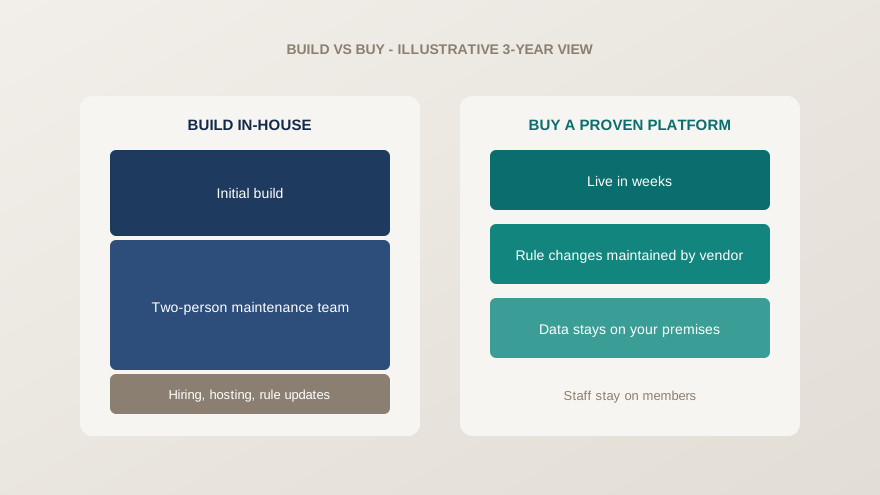
Time to a compliant release. A build takes months before the first usable version, and the model above assumes about nine. MyPF Software is a finished product: most organisations are fully live within two weeks, including historical data migration.
Keeping pace with rule changes. In-house, it depends on whether you still have the people who understand the code. With MyPF Software, our compliance team monitors EPFO circulars, notifications and court orders, and updates are deployed to all customers, typically within five business days of a regulatory change.
Developer dependency. In-house, knowledge sits with a few people. With a vendor, the codebase is maintained by a team whose only job is PF software, and continuity does not depend on any one person.
Ongoing cost. In-house, you carry salaries, recruitment, turnover and maintenance. With MyPF Software, regulatory updates, fixes and support are covered under the annual maintenance contract, with support levels set in your contract against member count.
Data control. Buying does not mean giving up control. MyPF Software is deployed on-premise, so your data stays on your own infrastructure.
Where your staff spend their time. In-house, your people are split between running the trust and running an IT project. With a vendor, they stay on members and operations.
Where MyPF Software Fits
MyPF Software is an on-premise PF trust management platform for exempted establishments in India. The trust keeps its data on its own infrastructure. We keep the calculations and compliance logic current. That split solves the two problems that stall in-house builds: the rules are handled by a team that does nothing else, and the trust's own staff go back to running the trust.
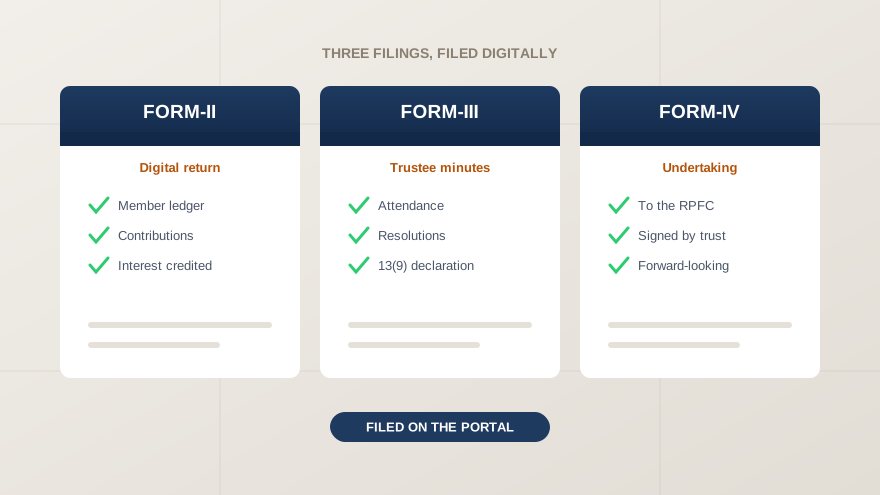
The platform already covers the work an in-house project would have to rebuild: member ledgers, interest crediting, investment tracking against the 85/15 pattern, and the EPF Scheme 2026 filing set. See the full feature list and how it maps to the compliance requirements. If you are still on spreadsheets, our guide to migrating from Excel to PF trust software explains what the move involves.
Questions Finance and HR Should Ask
Finance: Who signs off the rule changes when the next EPFO circular arrives, and how fast can we comply? What is the three-year cost of a build, including the people we will have to replace?
HR: What happens to member services if the one developer who knows the system leaves mid-year? How many weeks would employees wait for deductions, withdrawals or statements during a rebuild?
Put the same questions to any vendor you shortlist. Our buyer's guide to PF trust software lists the rest.
Before You Build Again
If your trust is still weighing an in-house application, ask three questions first. Who will maintain it when the next rule changes? What happens if the developer who built it leaves? And how many weeks will the trust be non-compliant while it catches up?
If the answers make you uncomfortable, it may be time to buy. And if you want a straight comparison before you decide, we will walk through your member count and your current setup and tell you honestly whether buying makes sense for your trust. Book a 30-minute demo or contact us.
Ready to simplify your PF trust compliance?
MyPF Software helps exempted PF trusts stay inspection-ready, automate filings, and manage investments — all in one platform built for India.