Table of Contents
Why the Annual Return Is Your Most Critical Compliance Document
The annual return is the primary compliance document through which an exempted PF trust formally accounts to EPFO for its operations over a full financial year. It encompasses member-wise contribution data, interest credited to each member's account, the trust's investment position, and evidence of trustee governance — making it the single most comprehensive snapshot of your trust's compliance health that EPFO receives. For inspectors conducting an exempted PF trust audit in India, the annual return is typically the first document examined, and any discrepancy between the filed return and the trust's internal records is among the most common triggers for escalated scrutiny and follow-up action.
Filing on time and filing accurately are equally essential and non-negotiable. The statutory deadline for the annual return for FY 2025-26 is 30 September 2026. Trusts that miss this deadline face automatic classification under the October 2023 SOP inspection priority list, meaning an accelerated inspection schedule. Addressing any gaps in your historical filing record before the next audit cycle is critical — as detailed in our comprehensive guide on what EPFO can do during an exempted PF trust audit in India.
Step 1: Compile and Reconcile Member Data
Begin by extracting a complete member-wise dataset from your contribution records for the full financial year. For each member, you require: the opening PF balance as at 1 April 2025, employee and employer contributions credited in each calendar month of FY 2025-26, total interest credited for the year at the applicable statutory rate, all withdrawals or transfers out processed during the year, and the audited closing balance as at 31 March 2026. Every figure in this dataset must be reconcilable to payroll records — discrepancies between payroll deductions and trust ledger credits are among the most frequently cited Category B violations under the SOP.
Reconcile your aggregate member liability — the sum of all member closing balances — against the trust's net assets as at 31 March 2026. Any gap between these figures must be identified and resolved before the return is submitted. Common sources of unreconciled differences include investment income not yet allocated to members, unrealised market movements in the portfolio, and administrative expenses that have been charged to the corpus without corresponding adjustments to member balances.
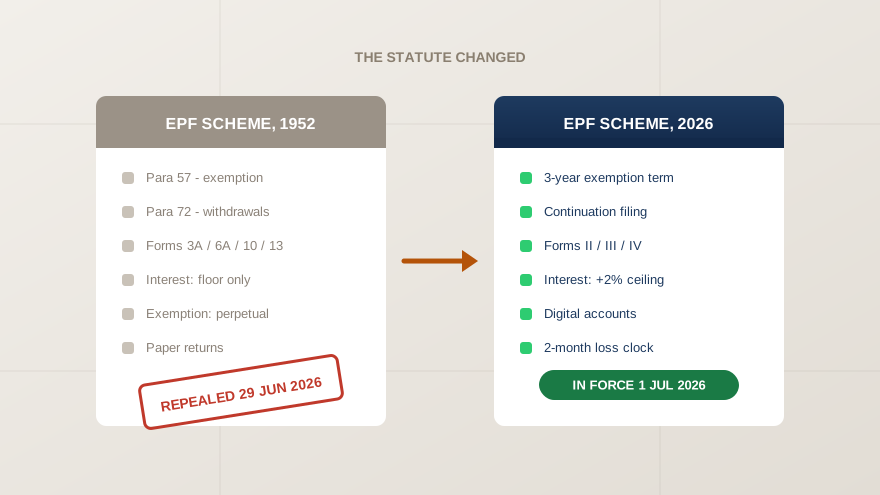
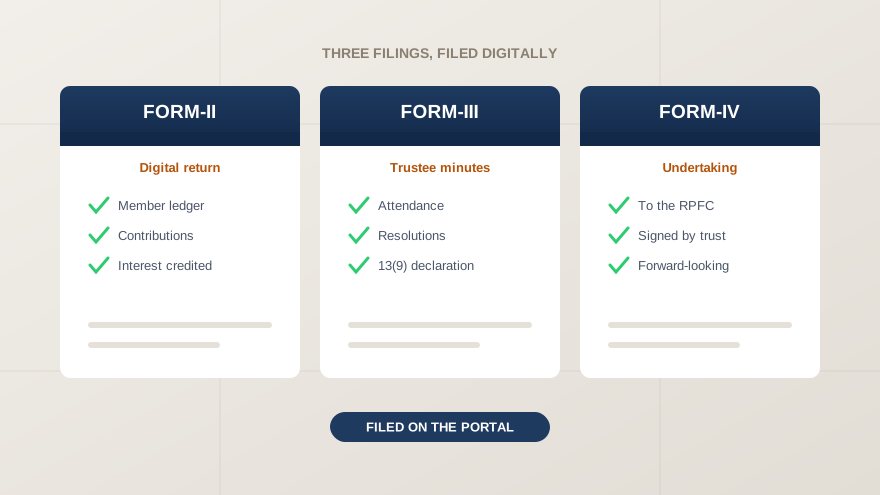
Step 2: Complete Form 3A and Form 6A
Form 3A is the member-wise annual contribution statement. It must be completed for every member who held an active account at any point during FY 2025-26 — including members who resigned, retired, transferred out, or passed away during the year. Each member's Form 3A must present monthly contribution details, the annual interest credited, and the verified closing balance. These forms are the foundation of EPFO's member-level data validation during an exempted PF trust audit in India.
Form 6A is the consolidated annual contribution statement, summarising total contributions received and total interest credited across the entire member base. It must reconcile exactly with the aggregate of all individual Form 3As. Any discrepancy between Form 3A totals and Form 6A summary figures will be flagged during inspection as a documentation error, triggering a request for a corrected submission and potentially delaying your inspection clearance.
Step 3: Prepare Investment Schedule and Audited Accounts
The annual return requires a certified investment schedule showing your trust's complete portfolio as at 31 March 2026, with the 85/15 compliance ratio explicitly computed and confirmed. This schedule must be signed and certified by the trust's statutory auditor. If your investment ratio was non-compliant at any point during the financial year, note the period of non-compliance, the quantum of the breach, and the corrective action taken — proactive disclosure is treated more favourably than a finding during inspection.
The trust's audited financial statements for FY 2025-26 — including the balance sheet and income-and-expenditure account — must also be submitted as part of the annual return package. These must be prepared in accordance with the accounting standards applicable to trusts and signed by a qualified Chartered Accountant. Ensure your auditor has specific familiarity with EPF trust accounting; general practice CA firms often overlook trust-specific income recognition and balance sheet treatment.
Step 4: Submit to EPFO and Retain Acknowledgment
Submit the complete return package to your EPFO regional office by 30 September 2026. The package must include: Forms 3A (for all members) and 6A, the certified investment schedule, audited financial statements, and a formal covering letter signed by the Board of Trustees acknowledging the accuracy of the submission. Retain a date-stamped acknowledgment copy as proof of timely filing — this document is the first thing you will be asked to produce if compliance is questioned during a future audit.
Several EPFO regional offices now accept or require digital submissions through the EPFO employer portal. Verify your regional office's current submission policy well before the deadline to avoid last-minute complications. If submitting in physical form, use registered post with acknowledgment or hand-deliver with a formal receipt.
For trusts managing large member bases, the data compilation and form preparation work involved in annual return filing is substantially simplified by dedicated compliance software. See our guide on choosing the right PF trust software in India for a full evaluation framework. MyPF Software auto-generates Forms 3A and 6A directly from your contribution records, flags reconciliation discrepancies before you file, and maintains a timestamped submission log for audit purposes. Contact us to discover how MyPF Software helps exempted trusts across India stay prepared for inspections throughout the year.
Ready to simplify your PF trust compliance?
MyPF Software helps exempted PF trusts stay inspection-ready, automate filings, and manage investments — all in one platform built for India.