Table of Contents
PF Trust Tax Exemption Under Budget 2026: Context and Overview
Union Budget 2026 has continued the progressive rationalisation of tax benefits for employee benefit funds that began with the landmark changes in Finance Act 2021. For exempted PF trusts, the Budget 2026 amendments have two principal implications: a revised methodology for computing which portion of employer contributions attracts income tax as a perquisite in the employee's hands, and a confirmed, universal extension of taxable interest provisions — first introduced in 2021 — to all high-contribution member accounts across every PF structure operating in India, including all exempted trusts.
The foundational PF trust tax exemption framework remains intact under Budget 2026: qualifying employer contributions continue to be deductible under Section 36(1)(iv) of the Income Tax Act, the trust corpus continues to grow on a tax-deferred basis, and compliant withdrawals by members after five years of continuous service remain exempt from income tax. However, the conditionality attached to these exemptions has been further tightened, and the thresholds above which employer contributions and interest income attract tax now capture a substantially larger proportion of members in exempted trust establishments.
The Revised Employer Contribution Threshold Under Budget 2026
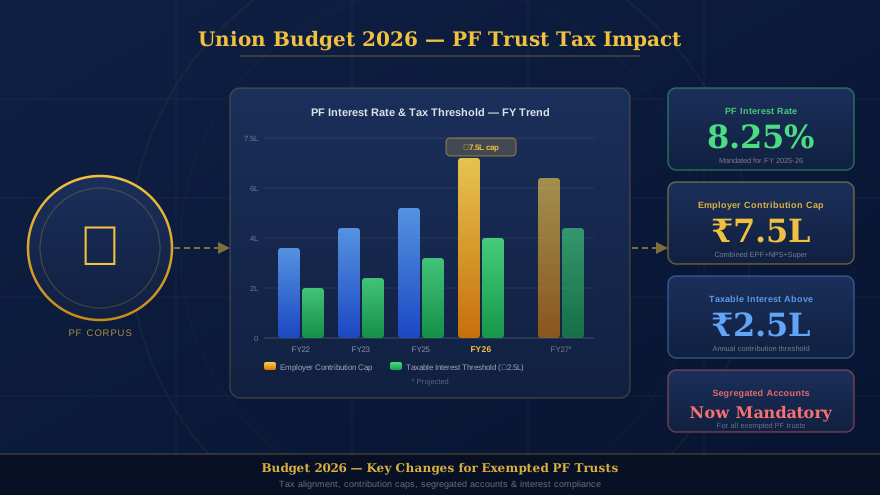
Budget 2026 has aligned and standardised the aggregate employer contribution threshold across EPF, National Pension System (NPS), and superannuation funds. The combined employer contribution to all three funds that exceeds ₹7.5 lakh per employee per financial year is now taxable as a perquisite in the employee's hands in the year of contribution, irrespective of whether the contribution is made to an EPFO account or to an exempted PF trust.
For exempted PF trusts serving senior and high-compensation employees — particularly in sectors such as manufacturing, financial services, information technology, and professional services — this change means that a subset of the trust's member base will generate TDS obligations on the excess employer contribution component. HR and payroll teams must identify this affected cohort, update their perquisite computation logic, and ensure that TDS is correctly deducted and deposited in the month the contribution is credited.
Taxable Interest on High-Contribution Accounts
The Finance Act 2021 introduced the taxation of interest accruing on PF contributions exceeding ₹2.5 lakh per year (applicable to private sector employees; the threshold for Central Government employees is ₹5 lakh). Budget 2026 has confirmed that these provisions apply universally and without exception to all exempted PF trusts, and has extended the requirement for segregated account maintenance — maintaining separate ledger accounting for the taxable and non-taxable portions of each qualifying member's account — to every exempted trust in India, regardless of current compliance status.
For members with annual contributions above the applicable threshold, the trust must: compute interest separately on the taxable and non-taxable portions of the account; deduct TDS on the taxable interest at the member's applicable income tax slab rate; report the taxable interest amount in the member's Form 16; and include the TDS deduction in the employer's quarterly TDS return (Form 24Q). This is operationally complex and requires member-level account segregation that cannot be managed reliably on manual systems.
What HR and Finance Teams Must Do Now
First, identify all members in your trust whose combined annual PF contribution (employee plus employer) exceeds ₹2.5 lakh. For each identified member, establish a segregated ledger from the first contribution that breaches the threshold, separately tracking the taxable and non-taxable account portions going forward.
Second, update your TDS computation and Form 16 generation processes. The taxable interest on the high-contribution portion must be computed using the member's applicable income tax slab rate, deducted before crediting, and reported accurately in the member's annual tax documents. Coordinate with your payroll and direct tax team to ensure the process is correctly integrated.
Third, evaluate whether your current trust management system supports segregated account treatment natively. If it does not, this constitutes an urgent and time-sensitive migration trigger. See our guide on choosing the right PF trust software in India for the evaluation framework. The Budget 2026 tax changes may also prompt a broader strategic review — for organisations where the compliance cost is rising alongside new tax obligations, the decision of whether to maintain exemption deserves rigorous analysis, as explored in our article on whether to surrender your PF trust exemption. Contact MyPF Software to see how our platform automatically manages Budget 2026 compliant segregated account management.
Ready to simplify your PF trust compliance?
MyPF Software helps exempted PF trusts stay inspection-ready, automate filings, and manage investments — all in one platform built for India.